





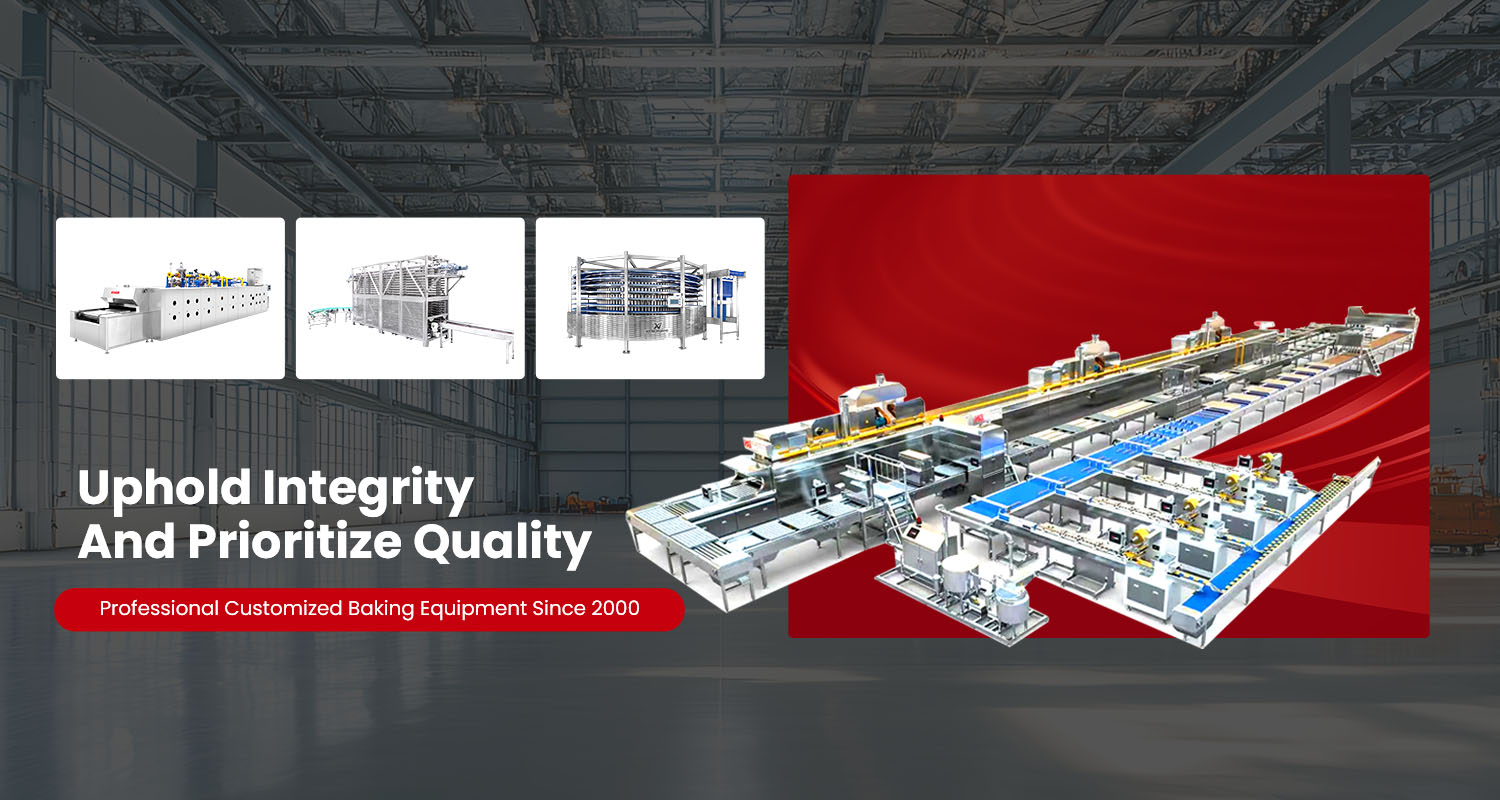
What Is an Automatic Industrial Bakery Production Line?
An automatic industrial bakery production line is a fully integrated system that transforms raw ingredients into consistent, high-volume baked goods with minimal manual handling. It links upstream ingredient storage and dosing with continuous mixing, forming, proofing/fermentation, baking, depanning, cooling, sorting, and packaging—coordinated by programmable controls for throughput, food safety, and traceability. KC-SMART (JM-KC) designs and manufactures these lines as one-stop solutions, from customized engineering and fabrication to on-site installation, commissioning, and after-sales service.
End-to-End Workflow
A modern bakery line is arranged for continuous flow:
Ingredient handling & dosing → automated flour/Dough Silo Systems meter ingredients to spec.
Mixing & dough development → horizontal or double-hook mixers achieve target dough temperature and gluten development profiles.
Dividing/forming → downstream equipment portions and shapes products before proofing.
Fermentation/proofing → spiral or vertical lifting Fermentation Towers provide controlled time, temperature, and humidity.
Baking → gas-fired tunnel ovens deliver uniform heat transfer for consistent crumb and crust.
Depanning → automated depanners protect product integrity while increasing throughput.
Cooling → Spiral Cooling Towers stabilize product core temperature for slicing or packing.
Sorting & packaging → automatic distribution, sorting, and packaging subsystems complete the line.
Core Modules From KC-SMART
Dough silo & mixing
KC-SMART provides Flour Dosing Stations and multiple mixer configurations to match recipes and target capacities. Accurate control of speed, time, and dough temperature protects quality across different formulas. (KC-SMART)
Fermentation towers
Spiral conveying or vertical lifting towers deliver reliable residence times for lean and enriched doughs while optimizing footprint and sanitation.
Gas-fired tunnel ovens
Centralized air-supply tunnel ovens support continuous baking with stable thermal profiles for breads, cakes, and biscuits.
Depanning & transfer
Automated depanners and conveyors reduce manual touchpoints and defects, preparing products for cooling.
Spiral cooling systems
Stainless-steel spiral coolers manage airflow and belt speed to reach packing temperatures quickly and uniformly, and can be retrofitted into existing lines.
Automatic sorting & packaging
Integrated distribution, sorting, and packaging modules synchronize with upstream output to reduce bottlenecks.
Typical Bread Line Specifications
The following specs illustrate a representative KC-SMART bread production line. Actual designs are customized to product, capacity, and plant constraints.
| Subsystem | Representative spec | Notes |
|---|---|---|
| Total capacity | 200 trays/hour | Continuous production target. |
| Fermentation tower | 5300×3020 size; turning 2.2; time 20 min | Stainless or plastic belt options. |
| Tunnel furnace | 2470×2350; 2 trays; baking time 20 min | Centralized air-supply gas-fired design. |
| Depanning | 5.5 kW; speed 1–6 | Automated depanning for consistency. |
| Cooling tower | Turning multiple 2.2; 20–120 min | Stainless or plastic belt; adjustable dwell. |
Automation, Controls, and Data
KC-SMART emphasizes intelligent automation across the line—PLC/HMI orchestration, recipe management, and coordinated speed control between mixers, proofers, ovens, coolers, and sorters. This reduces human error, improves repeatability, and provides data for capacity planning and continuous improvement.
Materials, Hygiene, and Safety
Equipment frames and contact parts are engineered for food environments, with stainless-steel construction, smooth surfaces, and clean-in-place-friendly layouts. Integrated guarding and interlocks protect operators while maintaining maintainability and access.
Customization & Scalability
Whether you’re upgrading a single stage (such as adding a spiral cooler) or planning a greenfield line, KC-SMART provides customized layouts, throughput options, and modular expansions. Guidance includes mapping your process, defining hourly targets, and aligning utilities and floor space before procurement—ensuring the line scales as demand grows.
Installation, Commissioning & Service
As a one-stop supplier, KC-SMART covers design, manufacturing, on-site installation, debugging, and after-sales support. This single point of accountability accelerates ramp-up and stabilizes quality across shifts.
Upgrade Paths For Existing Plants
If you already run a semi-automatic or manual line, targeted upgrades—spiral cooling, automated sorting, or oven modernization—can unlock capacity and reduce labor without a full rebuild. KC-SMART’s integration expertise focuses on airflow management, belt selection, and line synchronization to avoid downstream bottlenecks.
Planning Considerations
Throughput & SKUs: Define units per hour and product mix to size mixers, proofers, and ovens.
Residence times: Match fermentation, baking, and cooling dwell to product specs to protect texture and shelf life.
Utilities: Verify gas capacity for tunnel ovens and electrical loads for drives, blowers, and controls.
Footprint & flow: Use compact spiral solutions and vertical lifts to maximize floor area and hygiene zoning.
Downstream logistics: Coordinate sorting and packaging to prevent WIP accumulation after cooling.
Example Applications
KC-SMART supplies equipment and lines for breads, cakes, and biscuits, tailoring parameters like dough development, bake profiles, and cooling dwell to each category’s texture and surface requirements.
Frequently Asked Questions
What products can an automatic line handle? KC-SMART lines are configured for breads, cakes, and biscuits; each module (mixing, fermentation, oven, cooling, sorting) is tuned to product characteristics and target output.
Can I retrofit a spiral cooler to improve throughput? Yes. Spiral coolers can be integrated between baking and slicing/packing to stabilize core temperature faster and create a continuous flow in existing plants.
How do I determine the right capacity? Start by mapping current bottlenecks and defining hourly targets, then size mixers, proofers, ovens, and coolers to those constraints before final layout.
What are typical dwell times for bread? Representative specs include 20 min fermentation, 20 min baking, and 20–120 min cooling depending on loaf size and moisture.
What level of automation is available? Lines can run with recipe-driven control and synchronized speeds across all stages, minimizing manual adjustments and improving traceability.
Does KC-SMART provide installation and after-sales support? Yes—design, manufacturing, installation, commissioning, and ongoing service are included in the one-stop solution.
Getting Started
If you are planning a new line or upgrading an existing plant, assemble your product list, batch/throughput goals, utility specifications, and available space. Then align modules—dough handling, mixing, fermentation, tunnel oven, depanning, spiral cooling, sorting, and packaging—into a balanced, data-driven flow with KC-SMART’s engineering team.