





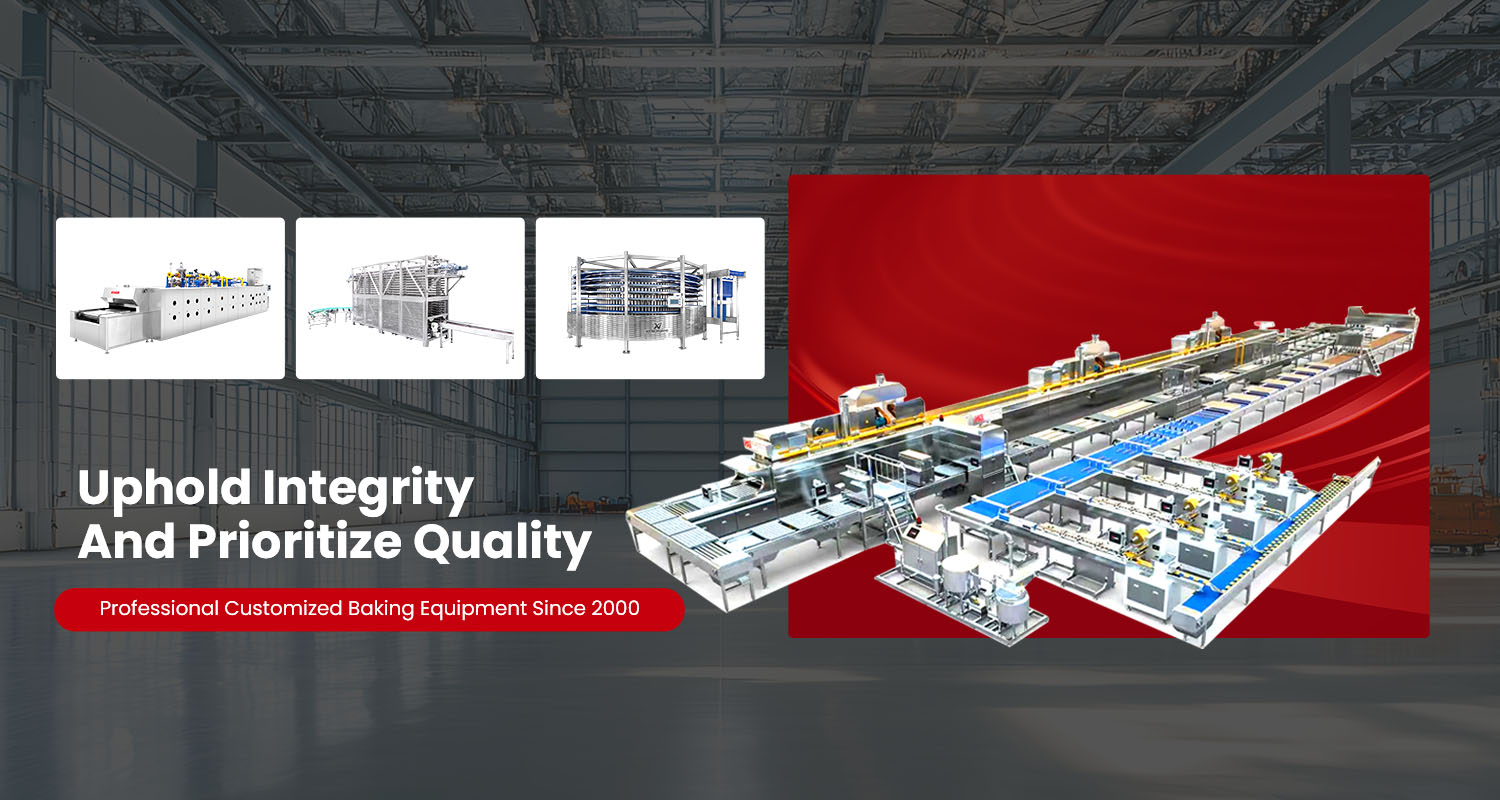
What Are the Benefits of a Gas-Fired Tunnel Oven for Baking?
A gas-fired tunnel oven is a continuous baking solution widely used in industrial bakery production lines. It uses gas combustion as the primary heat source and a tunnel-style conveyorized design that moves products through controlled zones of temperature and airflow. This structure delivers uniform heat transfer, high throughput, and energy-efficient baking. Below is a detailed exploration of the advantages of gas-fired tunnel ovens in modern baking operations.
Stable and Uniform Baking Quality
Gas-fired tunnel ovens achieve consistent baking results through:
Zoned temperature control across multiple sections of the tunnel, maintaining target profiles from crust formation to internal crumb structure.
Centralized air circulation that distributes heat evenly, reducing hot or cold spots on trays.
Precise dwell time as products move along the conveyor at controlled speeds tailored to specific bakery items.
Consistent thermal distribution minimizes over-baking and under-baking, ensuring uniform texture and color across batches.
High Production Throughput
Tunnel ovens support continuous operation rather than batch cycles. This design delivers:
Continuous loading and unloading without stops or downtime between batches.
High hourly capacity, suitable for large-scale bakery plants producing loaves, buns, cakes, or biscuits.
Synchronization with upstream and downstream systems (mixing, proofing, cooling, packaging) to sustain constant flow.
The uninterrupted nature of tunnel ovens enables stable output for peak production demands.
Energy Efficiency and Operating Cost Control
Gas-fired tunnel ovens often deliver better energy economics compared to batch or electric alternatives due to:
Efficient heat transfer through gas combustion with high thermal output and rapid recovery.
Lower energy cost per unit baked because gas prices are typically more favorable in industrial settings.
Insulation and heat retention systems that reduce wasted heat and minimize fuel consumption.
These characteristics help bakeries manage utility costs while maintaining output.
Flexibility for Diverse Bakery Products
Modern gas-fired tunnel ovens accommodate a wide range of bakery items:
Multiple heat zones adjustable to product characteristics — crusty bread requires different profiles than soft rolls or cookies.
Variable conveyor speeds that lengthen or shorten dwell times without manual intervention.
Adaptable airflow patterns that support products with diverse moisture and density profiles.
This flexibility allows a single oven line to switch between product categories while preserving quality standards.
Integration With Automated Production Lines
Tunnel ovens are pivotal in fully automatic bakery lines due to:
Seamless synchronization with proofers, depanners, coolers, and packaging systems.
Programmable conveyor speed and zone temperatures, enabling recipe-driven operation across the entire line.
Reduced manual labor in the baking stage, supporting consistent production schedules.
When part of an automated line, tunnel ovens contribute to improved productivity and reduced human error.
Improved Food Safety and Hygiene Control
Gas-fired tunnel ovens support hygienic operations through design features such as:
Closed-chamber baking that limits airborne contaminants and improves oven hygiene.
Accessible doors and panels for routine cleaning and inspection.
Stable combustion systems that maintain controlled atmospheres, reducing inconsistent heat effects on product surfaces.
These traits help maintain compliance with food safety standards and reduce quality risks.
Space-Efficient Layout
Compared with multiple batch ovens, tunnel ovens offer:
Compact footprint relative to throughput, especially when paired with vertical proofing or lifting systems.
Efficient floor utilization that supports other production modules without sacrificing capacity.
Modular design options that can be expanded or reconfigured as production needs evolve.
Tunnel ovens can serve as backbone components in both new installations and retrofit expansions.
Reduced Downtime and Maintenance
Industrial tunnel ovens are engineered for reliability with features such as:
Robust combustion and airflow systems designed for continuous operation.
Modular heating zones that allow targeted servicing without full shutdowns.
Automated controls that protect against thermal overloads and optimize maintenance schedules.
These factors lead to less unscheduled downtime and more predictable performance.
Enhanced Product Consistency Over Time
Because tunnel ovens operate continuously with programmable parameters, they deliver:
Repeatable production results from shift to shift.
Accurate replication of baking profiles across seasons and batches.
Reduced variability in finished goods, supporting brand quality standards.
Consistency is critical in commercial baking, where customer expectations and downstream processes depend on uniform product attributes.
Summary of Key Advantages
| Benefit Category | What It Delivers |
|---|---|
| Product quality | Uniform heat distribution, consistent crust and crumb |
| Throughput | Continuous flow, high hourly capacity |
| Efficiency | Lower fuel cost per unit, precise energy use |
| Flexibility | Adjustable zones and speeds for multiple products |
| Automation | Sync with full bakery production lines |
| Hygiene | Controlled baking environment with easy maintenance |
| Space utilization | High throughput with compact layout |
| Reliability | Low downtime and predictable maintenance |
Choosing a Gas-Fired Tunnel Oven
When selecting a gas-fired tunnel oven for a bakery production line, consider:
Target throughput aligned with hourly production goals.
Product range and the required bake profiles for each category.
Energy source availability and cost considerations in your region.
Integration requirements with proofing, cooling, and packaging systems.
Floor space and utilities layout to optimize plant organization.
These factors help ensure the oven’s capabilities match your operational needs.
A gas-fired tunnel oven is a powerful asset in industrial baking, providing stable quality, energy efficiency, space-optimized production, and integration with automated workflows. Its strengths support modern bakeries in scaling capacity, maintaining consistency, and managing operating costs for long-term performance.