





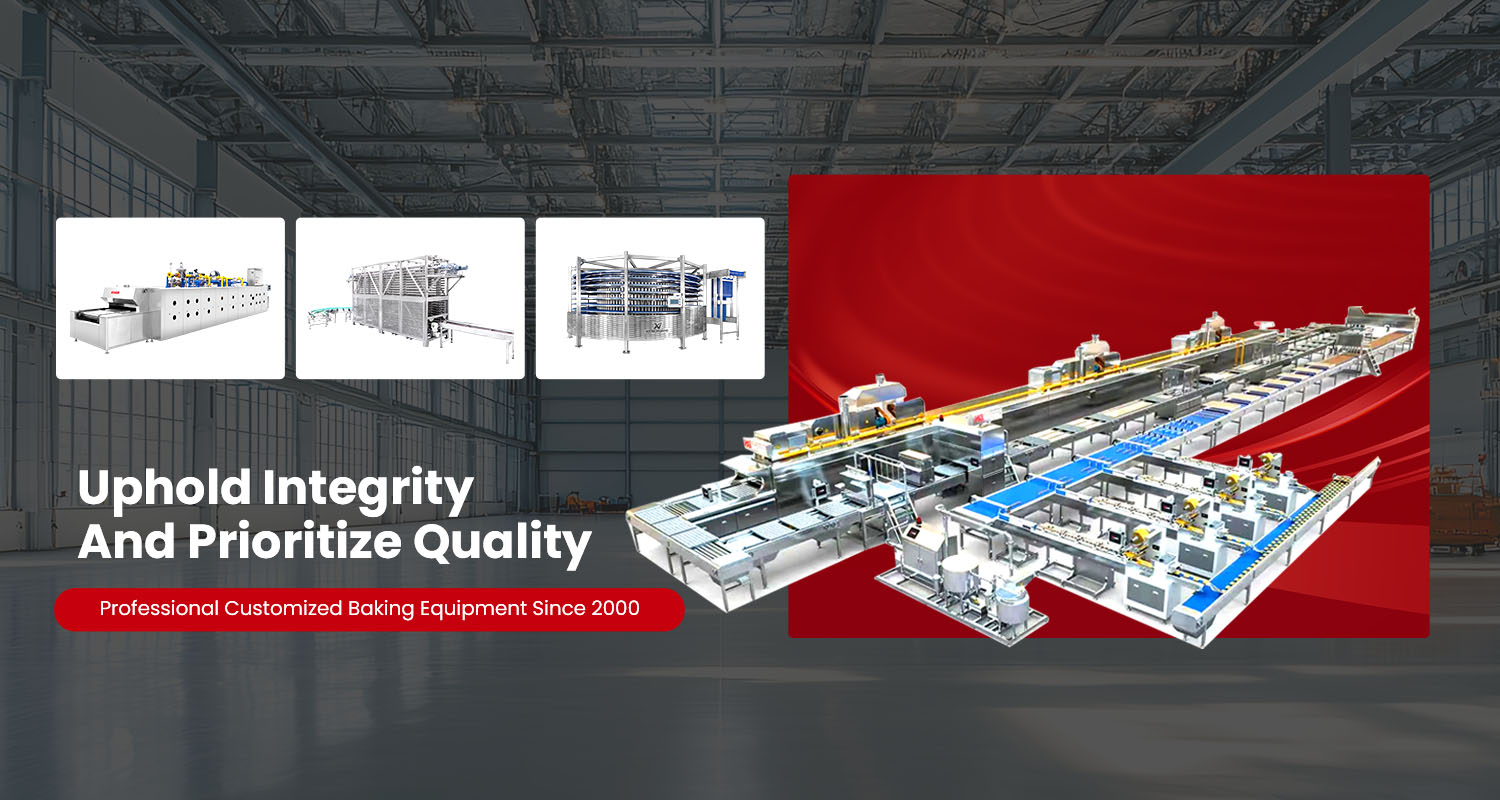
What Is a Gas-Fired Tunnel Oven?
A gas-fired tunnel oven is a continuous baking system that uses natural gas or LPG as the heat source and a conveyor tunnel structure to move products through controlled heating zones. Instead of baking in batches, products travel at a steady belt speed from loading to unloading, which makes tunnel ovens a core piece of equipment for high-output bakery lines such as bread, buns, cakes, and similar items. Industry references commonly describe tunnel ovens as multi-zone systems with adjustable top and bottom heat and controlled airflow for consistency.
From a manufacturer’s perspective, the value of a gas-fired tunnel oven is not only throughput, but also repeatability: stable heat generation, predictable residence time, and a tunable bake profile that can be matched to product size, moisture, and crust requirements.
How a Gas-Fired Tunnel Oven Works
A typical tunnel oven is built around three coordinated “controls”:
Heat generation and transfer Burners provide thermal energy. Depending on the design, heat can be delivered with direct hot-gas contact and circulation air, or via a heat-exchanger style approach. Direct-fired designs are widely recognized for high-intensity heat transfer and fast response, and tunnel ovens often use multiple zones so temperature and air turbulence can be staged along the bake path.
Zone control The tunnel is divided into zones that can be set differently to shape the bake curve. A practical example is a stronger initial zone for oven spring and crust formation, followed by gentler zones to finish internal crumb structure.
Conveying and time Belt speed defines residence time. This is one of the biggest quality levers because it sets how long the product experiences each zone’s heat and airflow.
What Makes Gas-Fired Designs Attractive in Production
Gas systems are popular in continuous baking for a few straightforward reasons:
Fast thermal response Gas combustion can react quickly to load changes, which helps stabilize baking conditions when product weight or line speed shifts.
High heat availability for continuous lines Process heating is a major part of industrial energy use. U.S. DOE materials often cite process heating as a significant share of manufacturing energy consumption, which is why reducing losses in ovens and combustion systems matters in real operating cost.
Combustion fundamentals are well understood For complete combustion, air-to-fuel control is critical. Guidance from U.S. energy technical resources notes that industrial combustion commonly operates with excess air to reduce risks like carbon monoxide formation and soot, and provides practical relationships between combustion air and heat release. This is why modern tunnel ovens typically emphasize stable ignition, flame supervision, pressure monitoring, and controlled exhaust.
Core Subsystems You Should Expect
When evaluating a gas-fired tunnel oven for a production line, these subsystems define performance and uptime.
Burner train and safety chain Look for intelligent ignition, flame failure detection, gas pressure monitoring, and interlocked exhaust. KC-SMART highlights safety functions like intelligent ignition, automatic exhaust extraction of residual waste gas, flame failure detection, and pressure monitoring in its gas-fired tunnel oven description.
Air circulation and distribution Uniformity is rarely achieved by heat alone. Air circulation design, ducting, and balanced top and bottom airflow are what make color and texture consistent across the belt width.
Exhaust and moisture management Removing moisture and combustion byproducts at the right rate can be just as important as temperature. Too little exhaust can cause pale crust and soggy texture. Too much can overdry products and waste energy.
Controls and recipe management Multi-zone setpoints, belt speed, and alarm logic should be easy to manage for operators. For continuous lines, stability and repeatability in controls often matter more than peak temperature.
Typical Specification Elements to Compare
Below is a practical comparison table you can use when collecting quotations or defining an OEM or ODM requirement.
| Item | What to define | Why it matters |
|---|---|---|
| Product type and size | length, width, height, target output per hour | Sets belt width, chamber height, and loading layout |
| Zone structure | number of zones, independent top and bottom heat | Enables a controlled bake curve for color and texture |
| Heat and airflow | circulation fan design, air distribution method | Drives uniformity across belt and between trays |
| Gas supply | gas type, inlet pressure stability, regulation strategy | Impacts ignition reliability and combustion efficiency |
| Exhaust | exhaust volume control, moisture removal strategy | Balances crust formation and internal moisture |
| Safety | flame detection, pressure monitoring, exhaust interlocks | Reduces operational risk and improves compliance |
| Maintenance access | panel layout, burner access, fan access | Reduces downtime and service cost |
KC-SMART Manufacturing Advantages in Gas-Fired Tunnel Ovens
If you want a tunnel oven that fits a specific line layout and capacity target, customization capability matters. KC-SMART positions its gas-fired tunnel ovens as customizable in length based on production capacity, which is a practical requirement for continuous lines where output is directly tied to baking length and belt speed.
KC-SMART also presents a broader intelligent baking equipment portfolio, which is relevant when you want a complete line solution rather than a single standalone machine. For project buyers, this is often the difference between integrating multiple independent machines and building a matched system with consistent control philosophy and mechanical interfaces.
Maintenance Practices That Protect Throughput
A tunnel oven is a long-life asset, but only if daily and weekly routines are treated as part of production.
Daily checks
Verify stable ignition and confirm no abnormal flame signal alarms
Check exhaust extraction performance, especially after shift changes
Confirm belt tracking and inspect for product debris buildup
Weekly checks
Inspect burner nozzles and air mixing condition
Review combustion air settings and verify the system is operating cleanly, stable air-to-fuel control supports safe combustion and avoids soot formation
Check circulation fans for vibration and bearing noise
Monthly or planned shutdown checks
Inspect insulation and door sealing areas for heat leakage
Validate zone temperature sensors and control loop stability
Review downtime logs and convert recurring issues into preventive actions
Final Takeaway
A gas-fired tunnel oven is essentially a controlled thermal tunnel that turns baking into a predictable, continuous process. The best results come from matching zone design, airflow distribution, exhaust strategy, and belt speed to your product’s bake curve, then protecting that recipe with strong safety logic and disciplined maintenance.
If you are sourcing for a commercial-grade production line and want customization aligned to capacity and layout, KC-SMART is positioned as a manufacturer with customizable tunnel length options and integrated safety features built for continuous baking operations.