





How to Improve Bakery Production Efficiency with Automation?
Bakery plants are under constant pressure to deliver consistent quality at higher throughput while controlling labor variability, energy use, and sanitation risk. The most reliable path is to redesign the line around measurable flow, then apply automation where it removes repeat losses, not where it only adds complexity. The bakery processing equipment market itself reflects this shift, valued at about USD 13.1 billion in 2025 with growth driven by automation and efficiency upgrades.
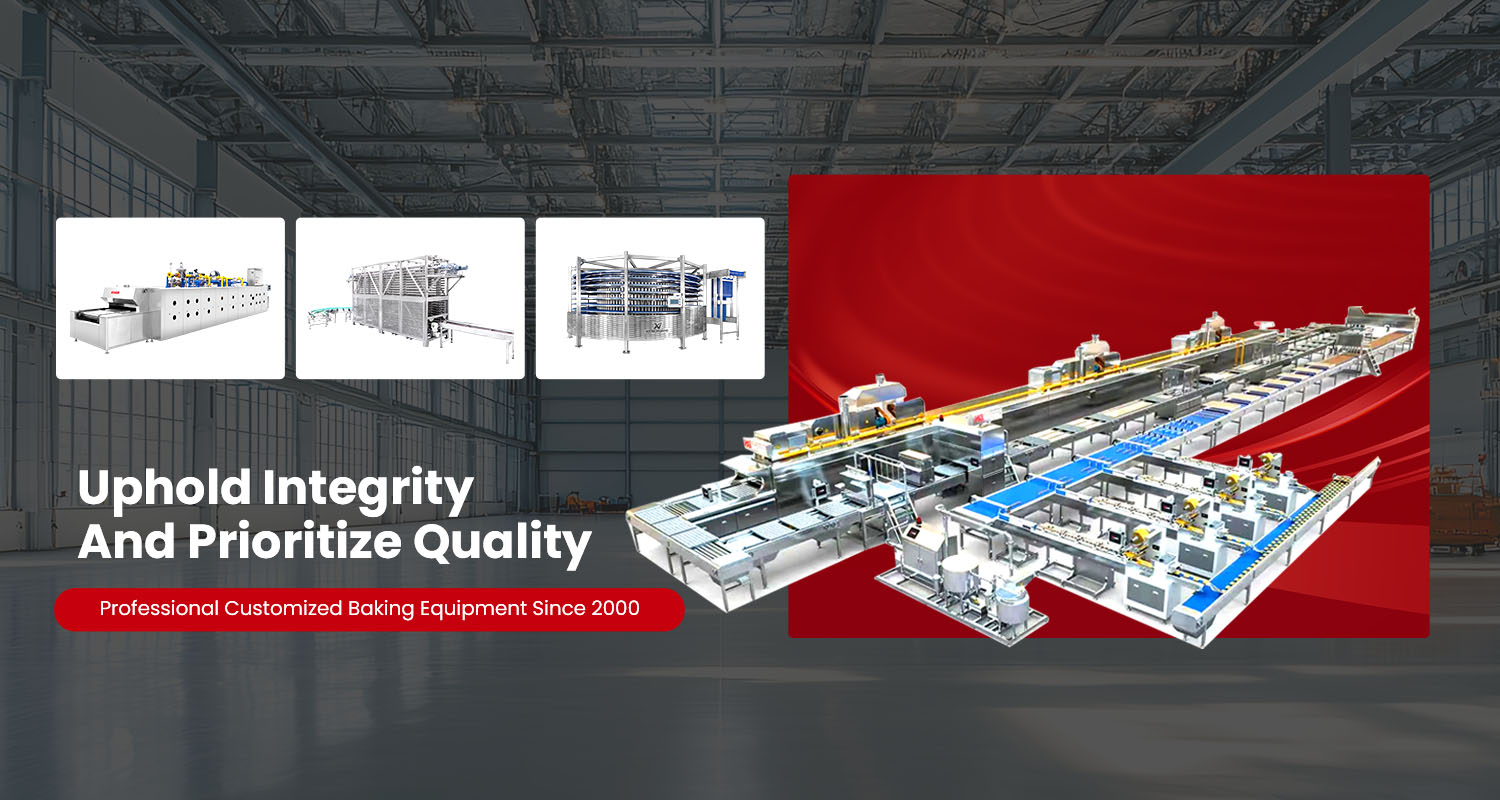
As a manufacturer, KC-SMART focuses on end-to-end line engineering and delivery, from customized design and fabrication to installation, debugging, and after-sales maintenance. With a dedicated production base and a product scope covering powder conveying, mixing, fermentation, baking, cooling, demolding, and material handling, KC-SMART builds integrated systems that stabilize output while improving line control.
Start With The Three Efficiency Levers That Matter
In most plants, efficiency gains come from improving three measurable areas:
Availability: reducing unplanned stops, micro-stops, and waiting time between steps
Performance: keeping each unit operation running at a stable target rate
Quality: minimizing rework, scrap, overweight, underbake, and deformation losses
This is why many manufacturers use OEE style logic to structure improvement. Common benchmark guidance treats 85 percent OEE as world-class, and below 60 percent as a clear signal of large losses that can often be corrected with standardization and automation.
Build Flow First, Then Add Control Points
A high-efficiency line is a controlled sequence, not a collection of fast machines. For bakery manufacturing automation, the most effective approach is to lock down flow with five control points:
Infeed and buffering that prevent upstream variation from starving ovens
Dough and batter preparation control that stabilizes viscosity, temperature, and dosing
Proofing and baking control that holds humidity, time, and thermal profile within target windows
Post-bake temperature management that protects structure and packaging readiness
Packaging handoff control that prevents jams and weight drift
KC-SMART designs these control points as part of an automated bakery production line so each step supports the next, reducing start-stop behavior that quietly destroys throughput.
Reduce Labor Variability Without Sacrificing Flexibility
Labor shortages and attendance variability directly affect daily output. In non-durable goods manufacturing, absence rate data reported by the US Bureau of Labor Statistics is about 2.9 percent in 2018, meaning planned staffing is routinely disrupted. This is where bakery production line automation delivers predictable capacity: automated conveying, dosing, transfer, and depanning reduce dependence on manual timing, while standardized recipes and guided changeovers reduce shift-to-shift drift.
A practical rule from the factory floor is to automate repetitive transfers first, then automate decisions through sensors and interlocks. This keeps flexibility for product mix while removing the most frequent labor-driven interruptions.
Stop Losing Energy To Idle Time And Unbalanced Scheduling
Baking is energy intensive, and efficiency is not only speed. Research on bakery line scheduling highlights that ovens are often left running during idle periods, creating avoidable energy waste and cost. Automation helps by synchronizing upstream proofing and downstream handling so the oven operates closer to steady-state production, with fewer gaps and fewer emergency slowdowns that harm product quality.
KC-SMART supports this with line-level coordination across mixing, fermentation, baking, and cooling so production rhythm matches real demand instead of running equipment independently.
Use Post-Bake Cooling As A Throughput Stabilizer
Cooling is a common hidden bottleneck. When products reach packaging too warm, you see deformation, condensation inside packs, label failure, and frequent line stops. The fix is not only more cooling capacity, but stable cooling time and controlled handoff. A spiral cooling conveyor design with adjustable travel time and monitored air conditions is a proven industrial approach to maintain texture while keeping continuous delivery stable.
This is also where bakery processing automation can protect both quality and speed: controlled cooling reduces packaging interruptions and helps downstream equipment run at the intended rate.
A Practical Automation Roadmap With Expected Outcomes
The table below maps common loss types to automation actions and what you should measure after implementation.
| Loss Type On Line | Automation Upgrade | What To Measure Weekly |
|---|---|---|
| Micro-stops and manual handoffs | Servo conveyors, automatic transfer, synchronized buffering | Stops per hour, average stop duration |
| Weight drift and giveaway | Closed-loop dosing, checkweigh feedback | Mean weight, standard deviation, giveaway rate |
| Proof and bake inconsistency | Recipe control, sensors, interlocks | First-pass yield, bake color variance |
| Cooling and packaging jams | Controlled cooling flow, paced discharge | Packaging uptime, jam frequency |
| Changeover downtime | Guided changeover steps, quick-connect design | Changeover minutes, restart scrap |
KC-SMART typically implements this roadmap as a single integrated line project, so improvements compound instead of shifting bottlenecks from one station to another.
Why KC-SMART Fits Automation-Driven Bakery Upgrades
KC-SMART was founded in 2000 and focuses on intelligent mechanical equipment and one-stop delivery, including custom design, manufacturing, installation, commissioning, and maintenance support. With coverage across powder transportation, mixing, fermentation, baking, cooling, demolding, and material handling, KC-SMART can design industrial bakery equipment as a coordinated system rather than isolated machines. That system approach is what converts automation spend into measurable throughput, stable quality, and predictable operating cost.
Conclusion
Improving bakery efficiency is a control problem before it is a speed problem. Define the flow, measure availability, performance, and quality losses, then apply automation where it removes repeat interruptions, stabilizes energy use, and protects post-bake handling. KC-SMART delivers bakery manufacturing automation with integrated engineering across the full process chain, helping plants move from reactive firefighting to stable, scalable production.
For a line review, share your product type, target output per hour, current bottlenecks, and sanitation requirements, and KC-SMART can propose an industrial automation layout with measurable checkpoints for commissioning and acceptance.