





How to Improve Bakery Production Efficiency?
Bakery plants rarely lose efficiency because of one big mistake. More often, output drops because small delays appear at every stage, from ingredient dosing and mixing to fermentation, baking, cooling, depanning, and sorting. When these stages are not balanced, labor rises, waste grows, and line speed becomes difficult to stabilize. That is why improving bakery production efficiency starts with the whole process rather than a single machine. Market demand is also pushing producers to upgrade faster. Grand View Research estimates the global bakery processing equipment market at USD 15.68 billion in 2025 and projects it to reach USD 27.12 billion by 2033, showing how strongly manufacturers are investing in more capable production systems.
Start with line balance, not just machine speed
Many bakeries try to raise hourly output by increasing oven speed or adding labor at the discharge end. That often creates a new bottleneck instead of solving the old one. Real efficiency comes from matching the capacity of upstream and downstream sections. A dough system that feeds unevenly will slow fermentation control. A stable oven without enough cooling capacity will still create congestion. A sorting section that depends on hand transfer can turn a continuous line into a stop and go operation.
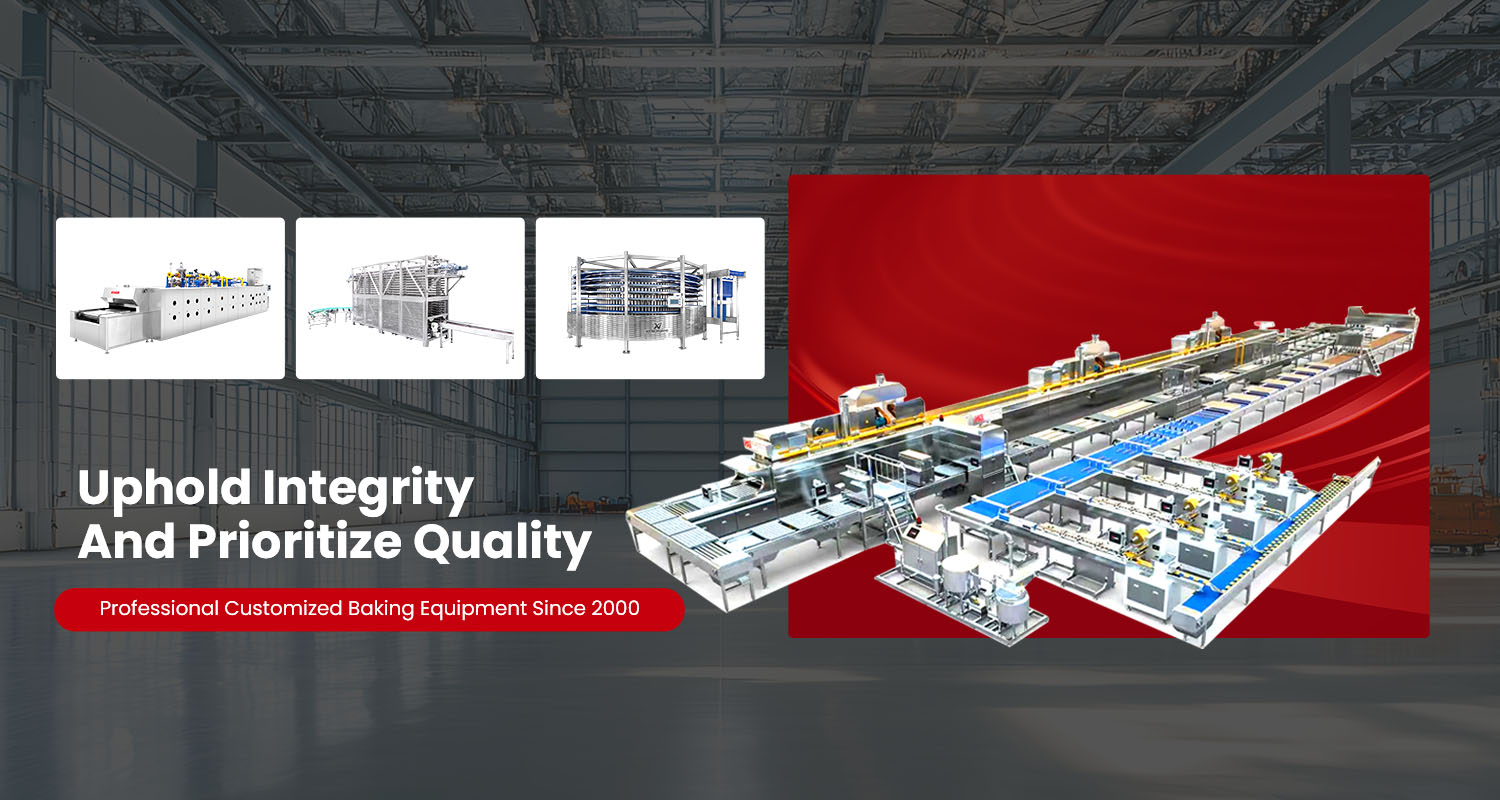
KC-SMART focuses on this connected view of production. Its product structure covers Dough Silo Systems, Fermentation Towers, Gas-fired Tunnel Furnaces, Spiral Cooling Towers, Depanning Machines, Automatic Sorting Lines, and supporting equipment. The company also presents itself as a one-stop supplier for design, manufacturing, installation, debugging, and after-sales service, which is important for plants that want smoother integration across the full line. Founded in 2000, KC-SMART states that it operates a facility of more than 10,000 square meters and serves global baking equipment demand with customized solutions.
Focus on the five losses that reduce output
A practical way to improve food processing efficiency is to identify the losses that appear most often in bakery operations.
Inconsistent material feeding
Flour and dough handling affect every stage that follows. When dosing is unstable, dough absorption changes, fermentation becomes harder to control, and finished product consistency starts to drift. KC-SMART’s Dough Silo System category includes flour dosing stations and mixers, which support more controlled ingredient transfer and batch preparation across the line.
Unstable fermentation conditions
Proofing time alone does not guarantee uniform fermentation. Temperature, humidity, transfer rhythm, and dwell time all matter. KC-SMART offers spiral conveying and vertical lifting fermentation tower options, which show its focus on controlled movement and continuous flow rather than isolated proofing steps.
Heat loss and uneven baking
Oven sections are often the highest energy and quality control point in the plant. Lawrence Berkeley National Laboratory notes that the baking industry has many cost-effective opportunities to reduce energy and water consumption through energy-efficient technologies and plant-level measures. In practice, that means tunnel oven control should be tied to product rhythm, heat distribution, and transport stability rather than treated as a standalone heat source. KC-SMART’s gas-fired tunnel furnace range is built around this central production stage.
Cooling bottlenecks
Cooling is where many lines lose hidden hours. Product can leave the oven correctly and still create downstream delay if it arrives too warm, too dense, or too slowly at the next station. KC-SMART’s Spiral Cooling Tower and vertical air-cooled cooling tower options are aimed at maintaining continuous flow after baking, helping reduce congestion before depanning, sorting, or packing.
High manual handling
Hand transfer adds labor cost, slows rhythm, and raises the risk of damage or inconsistency. KC-SMART highlights that its sorting line layouts can connect directly with upstream baking, cooling, and depanning equipment to reduce manual transfer and improve line continuity. This is one of the clearest ways to apply industrial bakery automation in a plant that wants stable throughput rather than isolated machine upgrades. (KC-SMART)
Use integrated equipment to remove bottlenecks
A bakery line becomes more efficient when each section supports the next one. The table below shows how integrated upgrades usually create stronger results than single-point changes.
| Production stage | Common efficiency issue | Better improvement direction |
|---|---|---|
| Ingredient dosing | Uneven feeding and recipe drift | Stable flour transfer and controlled dosing |
| Mixing | Variable dough development | Programmable mixing matched to product type |
| Fermentation | Irregular proofing rhythm | Continuous fermentation flow with controlled dwell time |
| Baking | Heat imbalance and energy waste | Coordinated tunnel oven control and line speed |
| Cooling | Product accumulation after oven | Spiral cooling sized to real production rhythm |
| Depanning and sorting | Labor-heavy transfer | Automated discharge and sorting continuity |
Build around measurable operating targets
Plants that truly improve bakery line efficiency usually manage three indicators together.
The first is throughput stability. A line that runs at a lower but stable speed often produces more saleable output than a faster line interrupted by stoppages.
The second is labor per unit. KC-SMART notes that automation reduces manual intervention, lowers labor cost, and reduces the risk of human error. For plants facing labor pressure, this can be just as important as machine speed.
The third is energy per unit. Since ovens and thermal stages carry major operating cost, even modest process improvements can change overall profitability. Lawrence Berkeley National Laboratory emphasizes that proven efficiency practices in the baking industry can lower energy-related cost while maintaining product quality.
Why supplier capability matters to efficiency
Equipment performance on paper does not always match plant performance after installation. Efficiency depends on whether the supplier understands process flow, control logic, line connection, and service response. KC-SMART positions itself around one-stop project support, covering customized design, manufacturing, installation, debugging, and maintenance. For bakeries building bread, cake, or mooncake lines, that broader capability reduces the risk of mismatched equipment and disconnected commissioning.
A smarter path to higher output
The best way to increase food production output is not simply to run faster. It is to create a line where dosing, fermentation, baking, cooling, depanning, and sorting move at a controlled and connected rhythm. When each stage is planned as part of a complete system, plants gain more stable output, lower labor dependence, better energy use, and more consistent product quality.
KC-SMART’s product coverage and one-stop engineering approach make that system view easier to achieve. For bakeries that are planning expansion or replacing older equipment, the most effective upgrade is the one that removes bottlenecks across the whole process and turns separate machines into one efficient production line.