





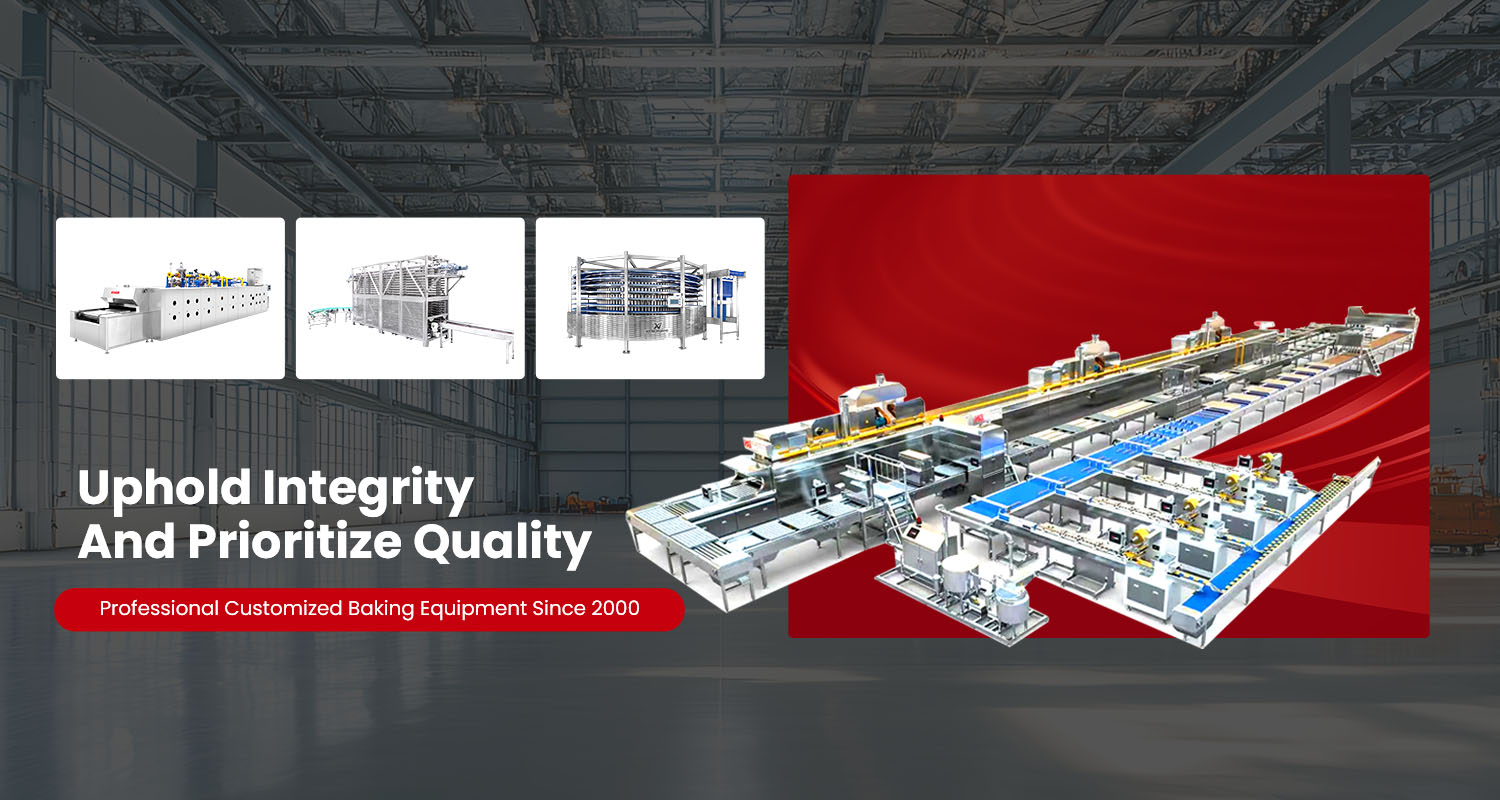
What Is the Bakery Equipment Supplier’s Role?
A bakery equipment supplier converts a production objective into machinery that can operate reliably under real factory conditions. The work extends beyond supplying ovens or conveyors. It includes evaluating recipes, calculating capacity, designing layouts, coordinating machine interfaces, supporting installation, and helping the finished line achieve its agreed performance.
Identifying the Correct Production Process
Equipment planning begins with the food rather than the machine. A supplier needs product samples or specifications covering dimensions, unit weight, dough characteristics, fermentation conditions, baking curve, cooling temperature, pan format, and packaging orientation.
These details determine whether the line needs flour silos, dough handling equipment, Fermentation Towers, brushing applicators, tunnel ovens, depanners, spiral cooling systems, or automatic sorting machines.
A food equipment manufacturer should also consider future recipes. Allowing reasonable adjustment in belt width, conveyor speed, temperature zones, and product spacing can reduce the need for major modifications when new products are introduced.
Calculating Capacity and Factory Requirements
Rated machine speed does not represent the output of a complete bakery. The industrial machinery supplier must compare cycle time and usable capacity across mixing, forming, proofing, baking, cooling, sorting, and packaging.
Factory conditions are equally important. The supplier should verify floor dimensions, ceiling clearance, structural loading, equipment access, drainage, ventilation, gas supply, electrical capacity, compressed air, and maintenance space.
Incorrect assumptions at this stage can result in restricted access, insufficient cooling time, oversized energy systems, or machines that cannot be moved into the building.
Managing Engineering and Manufacturing
Once the process is confirmed, the supplier develops equipment drawings, conveyor connections, operating heights, control logic, and utility schedules. Manufacturing should follow documented inspection procedures for materials, components, assembly accuracy, electrical systems, and safety functions.
For customized projects, buyers should receive regular confirmation of technical details. Changes to pan dimensions, product direction, packaging height, or factory layout can affect several machines, so revisions must be controlled before production progresses too far.
Integrating and Commissioning the Line
An industrial food machinery provider is responsible for making separate machines function as a coordinated line. Sensors and communication signals should manage speed changes, product accumulation, downstream faults, and controlled restart sequences.
During commissioning, testing should use representative products and realistic operating conditions. Evaluation should cover:
Accepted products per hour
Baking color and internal consistency
Transfer stability and product damage
Temperature and conveyor-speed control
Alarm, interlock, and emergency functions
Changeover and cleaning procedures
Evaluating the Supplier’s Complete Responsibility
| Project Stage | Questions Buyers Should Ask |
|---|---|
| Consultation | Does the supplier understand the product process? |
| Engineering | Are capacity and utility calculations provided? |
| Manufacturing | How are machines inspected before shipment? |
| Installation | Who handles positioning, connection, and alignment? |
| Commissioning | Which performance criteria will be tested? |
| After-sales service | Are training, parts, and remote support available? |
To choose a bakery equipment supplier, compare technical responsibility, project experience, documentation, and service response alongside price. The most suitable partner is one that can manage the connections between product, machinery, controls, utilities, and factory operations—not merely deliver individual equipment.