





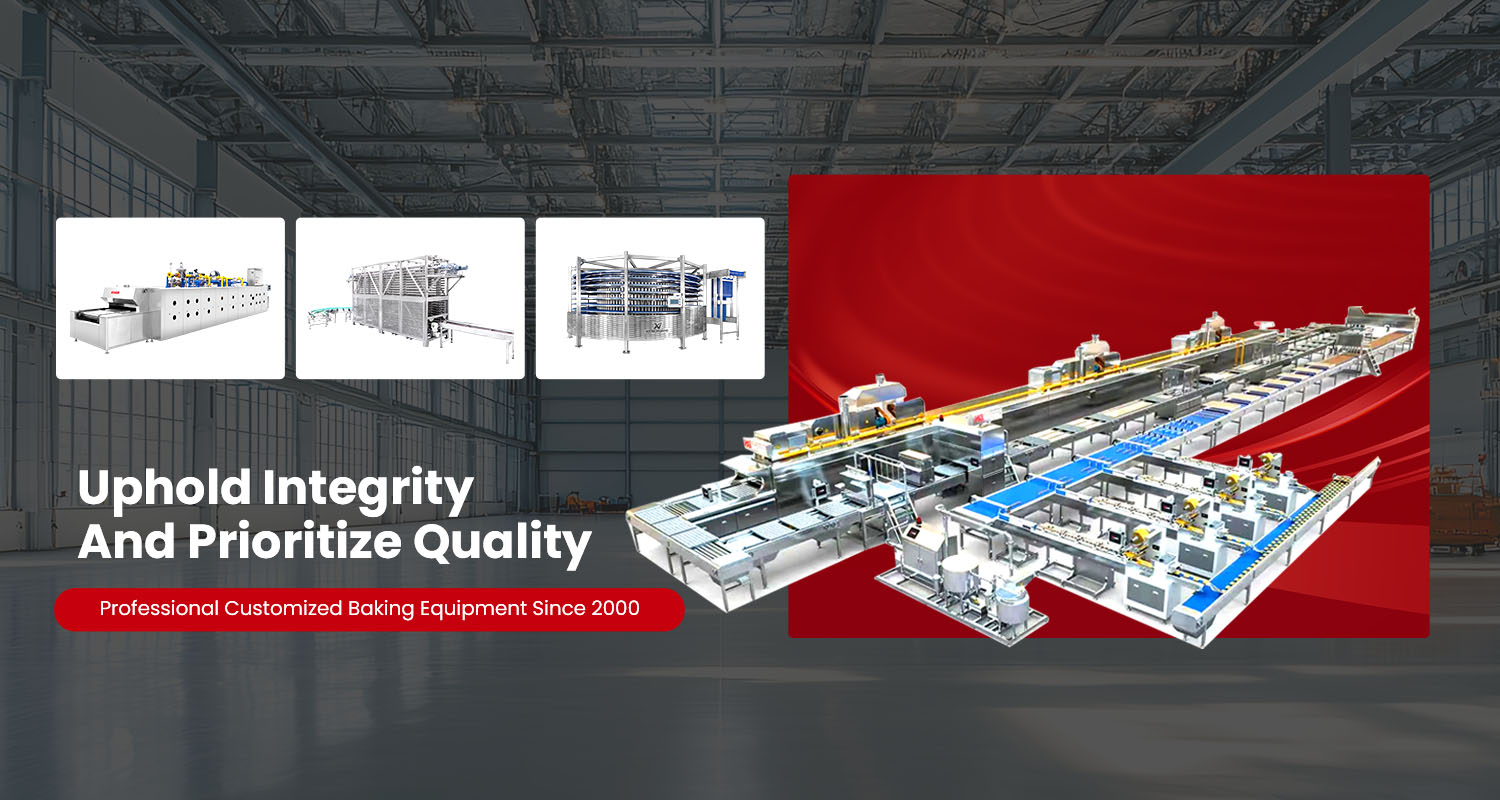
How to Select an Industrial Baking System?
Selecting an industrial baking system requires matching thermal performance and production flow to the product. Oven type, heating method, belt width, baking time, airflow, exhaust, energy source, and automation must be evaluated together. The best system is the one that repeatedly produces the required quality at a sustainable operating cost.
Start with Product and Capacity Requirements
Prepare specifications for every planned product, including dimensions, weight, moisture, recipe type, baking temperature, residence time, desired color, and final texture. Indicate whether products travel on pans, trays, mesh belts, stone surfaces, or steel belts.
Capacity should be expressed as accepted pieces or kilograms per hour. Manufacturers also need row arrangement, spacing, operating hours, and the expected product changeover frequency. These details determine oven width, length, number of temperature zones, and conveyor-speed range.
Bakery production equipment placed before and after the oven must be considered at the same time. Proofing output should match oven loading, while depanning and cooling equipment must receive the baked products without creating congestion.
Compare Heating and Airflow Designs
Gas-fired, electric, and hybrid ovens offer different installation and operating characteristics. The appropriate option depends on local energy availability, cost, factory infrastructure, emissions requirements, and required temperature response.
Heating method alone does not determine baking quality. Airflow distribution, burner arrangement, insulation, chamber geometry, exhaust control, and conveyor loading all influence temperature uniformity.
Request information about left-to-right heat consistency and independent zone control. Products with different top and bottom color requirements may need separate adjustment of upper and lower heat. Moisture-sensitive products also require controlled exhaust rather than constant maximum extraction.
Assess Controls, Changeovers, and Maintenance
A modern food processing system should store product recipes for temperature, belt speed, airflow, and exhaust settings. Operators should be able to retrieve approved parameters without manually rebuilding the complete baking profile.
Useful selection criteria include:
Temperature-zone quantity and adjustment range
Conveyor speed accuracy and minimum operating speed
Automatic ignition and burner-safety functions
Overtemperature and conveyor-stop protection
Production history and fault recording
Inspection doors and cleaning access
Accessibility of fans, motors, burners, and bearings
Factories producing multiple SKUs should ask how long the oven takes to stabilize after recipe changes. Excessive transition time can reduce daily output and create off-specification products.
Evaluate the Complete Production System
An industrial oven should not be purchased as an isolated machine. To choose an industrial baking solution, confirm equipment interfaces, operating heights, control signals, emergency logic, gas or electrical connections, exhaust routing, and installation responsibilities.
The proposal should show:
| Evaluation Area | Required Confirmation |
|---|---|
| Baking result | Color, moisture, texture, and uniformity |
| Usable capacity | Accepted output under normal operation |
| Energy conditions | Fuel type, connected load, and consumption basis |
| Factory compatibility | Space, ventilation, access, and safety |
| Line integration | Proofing, loading, depanning, and cooling |
| Acceptance test | Products, test duration, and performance limits |
To optimize a bakery production system, compare lifecycle value rather than only purchase price. Stable heat distribution, effective insulation, accessible maintenance, repeatable controls, and coordinated line capacity can produce greater long-term savings than a lower initial investment.
A correctly selected industrial baking system supports consistent products, balanced production, manageable energy use, and enough operating flexibility for future recipes.