





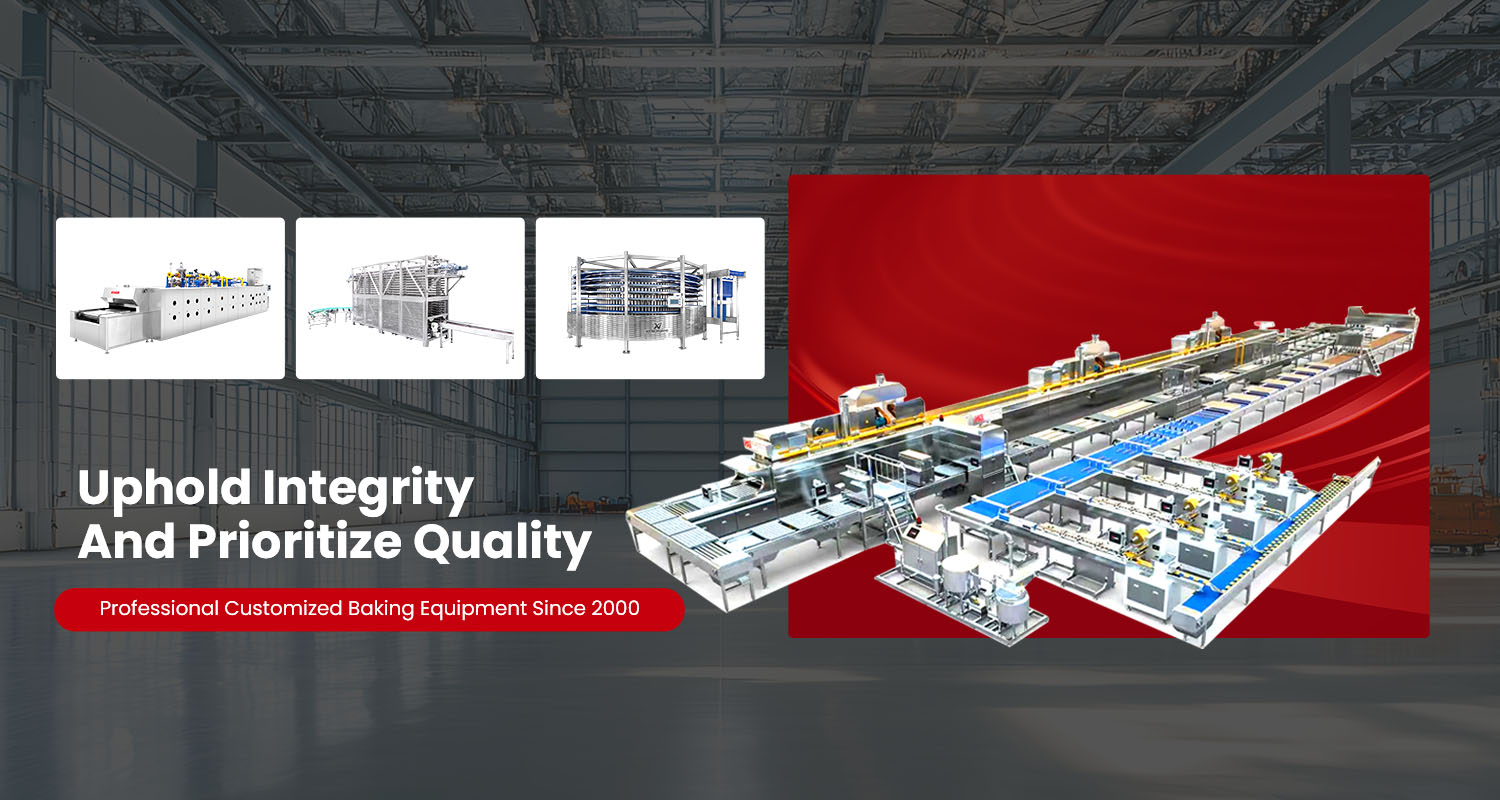
How Can New Equipment Fit an Existing Line?
Adding a new oven, cooling tower, depanner, mixer, or sorting unit to an operating bakery is more complex than placing a machine in an available area. Product flow, conveyor height, speed, controls, utilities, hygiene, and maintenance access must work together. A carefully planned bakery line integration system allows new equipment to improve capacity without creating another bottleneck elsewhere.
Begin With the Existing Production Flow
The first step is to document how products currently move from one process to the next. This includes actual output during normal production, transfer delays, accumulation points, product damage, cleaning stops, and operator interventions.
Rated machine speed alone is not sufficient. An oven may discharge continuously while an existing packaging machine stops periodically. Without accumulation or synchronized control, the new equipment could push products into a stopped downstream section.
A practical site study should record:
Product dimensions, weights, and spacing
Conveyor widths, heights, and travel directions
Minimum and maximum operating speeds
Current production capacity and planned expansion
Available electrical, gas, air, water, and exhaust connections
Column positions, doors, drains, and ceiling restrictions
Cleaning zones and maintenance access
Upstream and downstream control signals
These details provide the engineering basis for existing bakery equipment integration.
Match Capacity Across the Whole Line
New machinery should not be sized only according to the highest theoretical speed. It needs to support the sustainable output of the complete line.
Installing a faster depanner will not raise production if cooling remains undersized. A larger oven may also create problems when conveyors, sorting equipment, or packaging machines cannot accept the additional output. Capacity calculations should therefore include operating efficiency, changeovers, cleaning, minor stops, and product rejection.
Where speeds differ, accumulation conveyors or controlled buffers may be required. These sections give downstream equipment time to recover from short stops without forcing an immediate shutdown of the oven or upstream processing equipment.
Protect Products at Every Transfer
Transfer points often determine whether an integration succeeds. Bread, cakes, and other bakery products may slide, rotate, overlap, or deform when conveyor heights and speeds are mismatched.
The engineering team should consider drop height, belt material, gap size, guide-rail position, product center of gravity, and surface condition. Fragile products require especially gentle transitions. Testing with actual products or representative samples helps identify risks that drawings alone may not reveal.
The entry and discharge direction of spiral systems also deserves attention. A tower may fit physically but still require awkward conveyor routes if its inlet and outlet elevations do not align with existing machinery.
Connect the Controls Safely
Mechanical fit is only part of the project. Machines must exchange start, stop, fault, speed, and product-presence signals. The integration plan should define what happens when any section stops and how operators restart production safely.
Older equipment may use different communication methods from new machines. An interface panel, additional sensors, variable-frequency drives, or control updates may be necessary. Emergency-stop circuits and safety interlocks must be coordinated across the connected sections.
Operators should have clear fault information rather than seeing only a general line-stop alarm. Accurate diagnostics shorten downtime and prevent repeated manual troubleshooting.
Plan Installation Around Production
Bakery factories often cannot stop for long periods. Installation should therefore be divided into preparation, equipment positioning, connection, dry testing, product testing, and production handover.
Utility points, support structures, cable routes, and conveyor interfaces can sometimes be prepared before the main shutdown. Equipment dimensions must also be checked against doors, corridors, lifting capacity, and assembly space.
KC-SMART reviews site drawings, existing-machine data, product requirements, and shutdown limitations before proposing integration work. As a custom automation line manufacturer, we focus on how each new section communicates with the complete process.
Successful integration is measured by stable flow after commissioning. Correct capacity matching, gentle transfers, coordinated controls, accessible maintenance areas, and a realistic installation schedule allow new equipment to strengthen the existing line instead of disrupting it.