





What Is The Working Principle Of A Spiral Cooling Tower?
After baking, bakery products continue releasing heat from their internal structure. Packaging products before they have cooled sufficiently may cause condensation, affect surface texture, and reduce storage stability. Industrial bakeries therefore need a reliable cooling process that can handle continuous production without creating unnecessary delays between the oven and packaging sections.
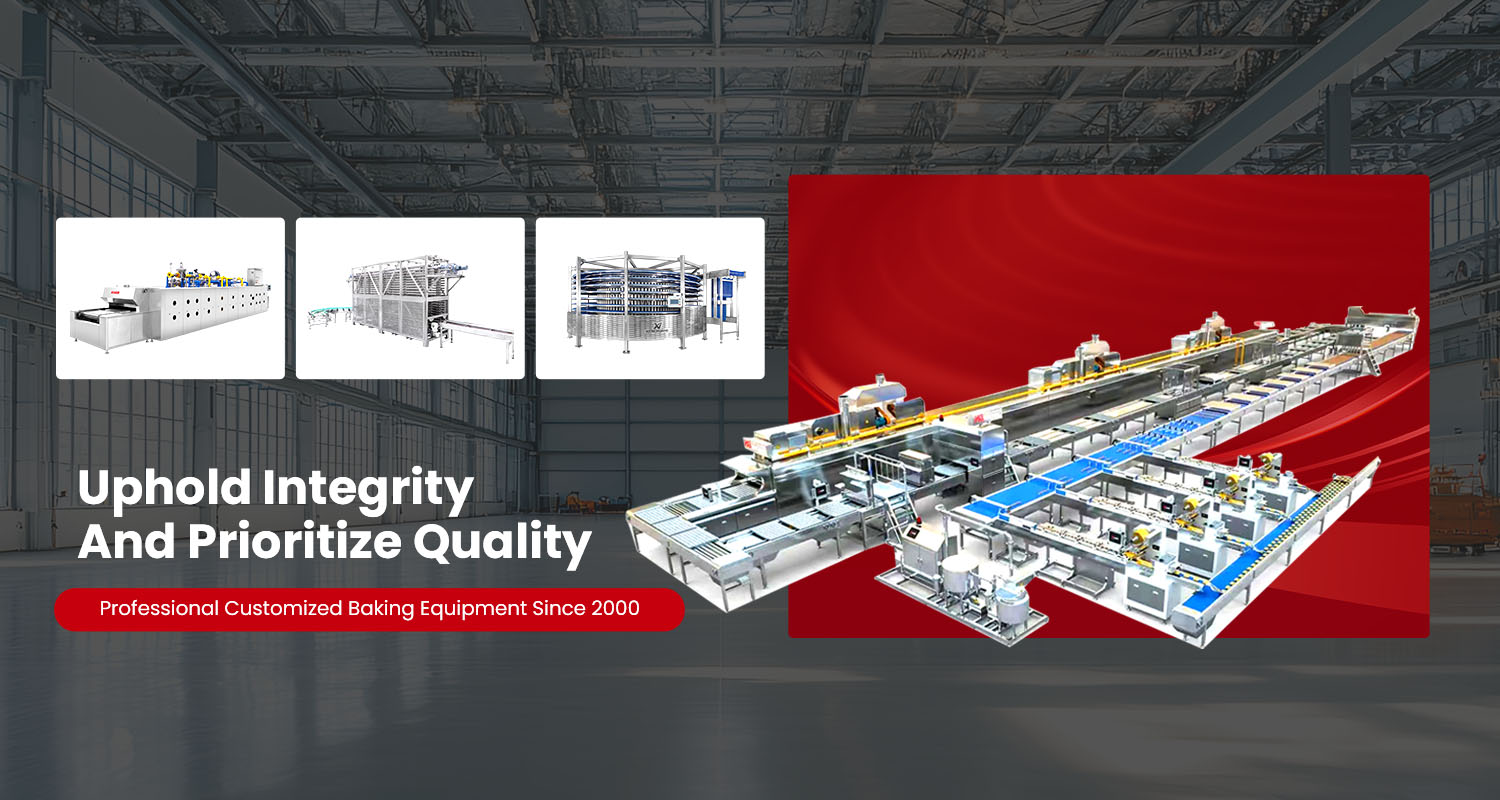
A Spiral Cooling Tower System solves this problem by moving baked products along a long, continuous conveyor arranged in a vertical spiral structure. Instead of requiring a large horizontal cooling area, the system uses multiple conveyor levels to provide sufficient cooling time within a relatively compact factory footprint. Its operation combines controlled conveying, air circulation, and temperature management.
1. How Does the Spiral Conveying Process Work?
The working process begins when baked products enter the cooling tower through an infeed conveyor.
The products are transferred onto a continuous spiral belt that gradually moves upward or downward through multiple layers. As the conveyor travels through the tower, products remain separated and receive time for heat dissipation.
The process generally follows this sequence:
Product infeed: Warm bakery products enter from the oven discharge conveyor.
Spiral transportation: The conveyor moves products through multiple vertical levels.
Heat dissipation: Products release heat while air circulates around them.
Temperature reduction: Continued movement allows internal and surface temperatures to decrease.
Product discharge: Cooled products leave the tower and move toward packaging or the next processing stage.
The conveyor speed determines how long products remain inside the cooling tower.
2. What Are the Main Components?
A spiral cooling tower contains several interconnected mechanical and cooling components.
| Component | Function |
|---|---|
| Spiral conveyor belt | Transports products through multiple levels |
| Drive system | Controls conveyor movement |
| Supporting structure | Maintains belt stability |
| Air circulation system | Distributes cooling air |
| Infeed conveyor | Transfers products into the tower |
| Discharge conveyor | Connects cooling with downstream equipment |
| Control system | Coordinates speed and operating conditions |
The design of each component affects cooling stability, maintenance accessibility, and continuous production performance.
3. How Does Heat Leave the Bakery Products?
Cooling mainly occurs through heat transfer between warm products and the surrounding air.
Three mechanisms are involved:
Convection: Moving air carries heat away from the product surface.
Conduction: Heat moves from the warmer interior toward the cooler surface.
Radiation: Products exchange thermal energy with surrounding surfaces.
Air circulation is particularly important because it removes warm air around the products and helps maintain a more consistent cooling environment.
However, excessive airflow may dry certain bakery products. Air speed and temperature should therefore match the product characteristics.
4. How Is Cooling Time Determined?
The required cooling time depends on product thickness, initial temperature, target discharge temperature, and airflow conditions.
A basic relationship for estimating conveyor residence time is:
Cooling Time = Effective Conveyor Length / Conveyor Speed
For example, if the effective conveying path is 180 meters and the conveyor speed is 6 meters per minute, the theoretical residence time is 30 minutes.
Actual cooling performance must still be verified through product temperature measurements because conveyor residence time alone does not determine the final temperature.
5. Why Is the Spiral Structure Useful?
The main advantage is its ability to provide a long conveying path without occupying an equally large horizontal area.
This arrangement offers several benefits:
Supports continuous bakery production.
Reduces the required floor space.
Provides adjustable cooling residence time.
Connects directly with upstream ovens.
Supports automated transfer to packaging lines.
For factories with limited installation space, vertical conveyor arrangements can make production layout planning easier.
6. What Affects Cooling Tower Performance?
Several factors should be evaluated during equipment selection and commissioning:
Product dimensions, weight, and moisture content.
Oven discharge temperature.
Conveyor loading density and product spacing.
Air temperature and circulation uniformity.
Required discharge temperature.
Conveyor speed and daily production output.
KC-SMART considers these production factors when planning bakery cooling equipment and line integration.
Conclusion
A spiral cooling tower works by transporting warm bakery products through a continuous vertical conveyor path while circulating air to remove heat. Its performance depends on conveyor speed, airflow, product characteristics, and required cooling time. Correctly matching these parameters helps bakeries maintain stable production between oven discharge and packaging while making efficient use of available factory space.