





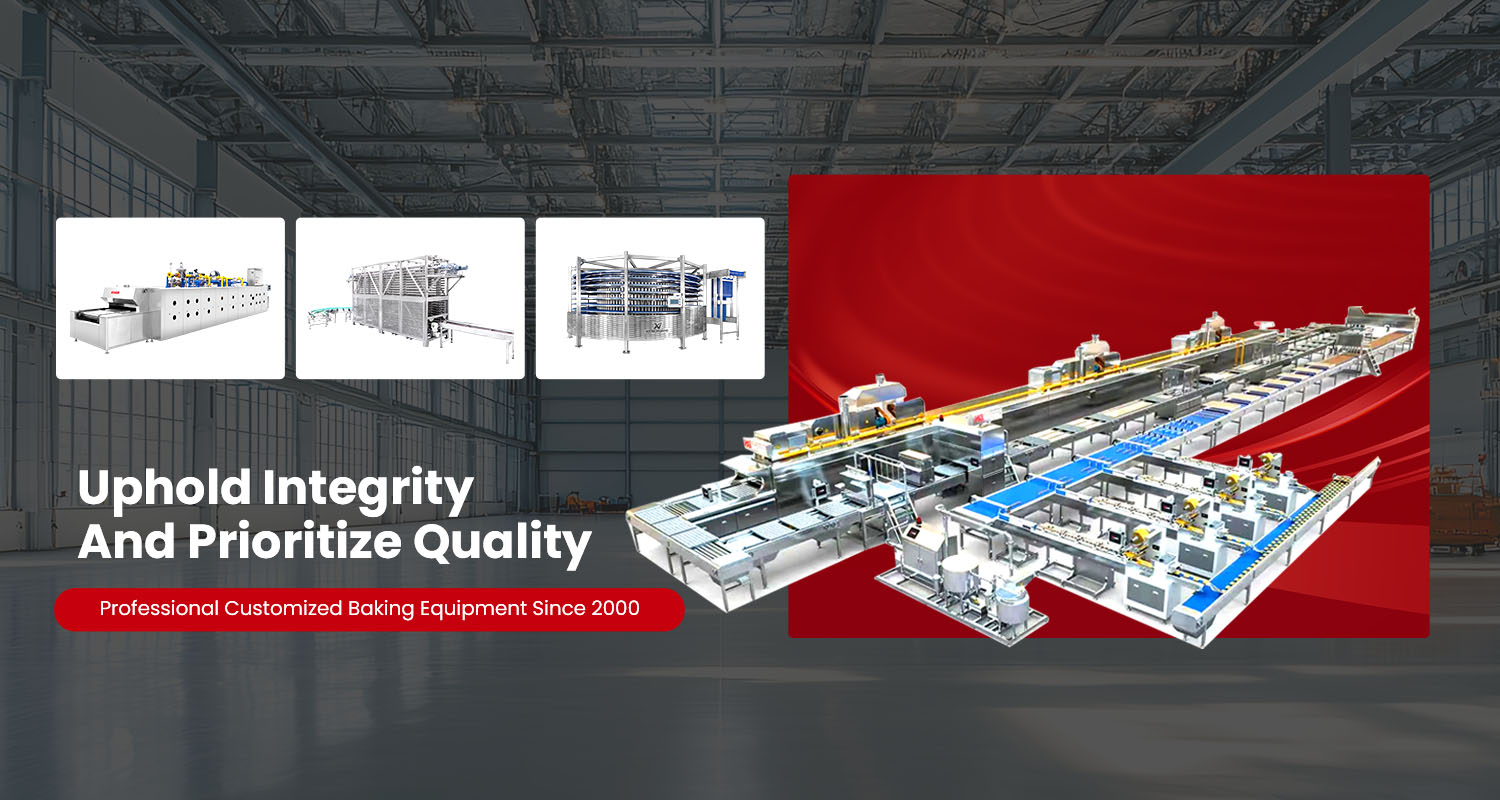
What Types of Tunnel Ovens Are Available Today?
Industrial bakeries and large-scale food-processing facilities rely heavily on tunnel ovens — continuous baking systems that move products through a heated chamber on a conveyor belt. These ovens enable high-volume, consistent production with minimal manual work.
What is a Tunnel Oven
A tunnel oven is a long chamber equipped with a conveyor belt system. Dough, pastries, biscuits, breads or other products enter one end and exit the other, having passed through multiple temperature/humidity zones. This continuous flow contrasts with batch ovens that bake products in discrete loads.
Key structural features:
Conveyor belt system – moves products steadily through oven.
Multi-zone baking – different zones along the tunnel allow distinct temperature and humidity control, so delicate pastries and crusty breads can both be baked under optimal conditions.
Continuous operation and automation – minimizes manual labor and ensures uniformity across large batches.
Because of these characteristics, tunnel ovens are the backbone of modern bakery automation and industrial baking lines.
Main Types of Tunnel Ovens
Tunnel ovens are usually differentiated by their heat source / heating method. The most common types are:
| Oven Type | Heat Source / Method | Typical Use & Characteristics |
|---|---|---|
| Gas-fired (Gas) Tunnel Oven | Gas burners installed within or adjacent to the baking chamber; combustion (direct or with air circulation) provides heat | Ideal for high-volume bread, pizza, or heavy-duty baked goods. Provides rapid heat-up and recovery, and often lower per-unit operating cost if gas is cheaper. |
| Electric Tunnel Oven | Electric heating elements (e.g. resistance heaters) or other electric heating technology, with air circulation for uniform heat | Offers precise temperature control, uniform heat distribution — good for delicate pastries, biscuits, items requiring consistent, even baking. Installation is easier (no gas line, no complex ventilation). |
| Hybrid / Combined Tunnel Oven | Combination of gas and electric (or convection/heated-air) sections or modes, possibly switching between or blending methods | Offers flexibility: can adapt to different product types during same production line — e.g. use gas-fired zones for rapid baking and electric/convection zones for gentle finishing, or for products needing different baking characteristics. |
In addition, manufacturers may provide variants such as direct-fired vs indirect-fired within the gas ovens (burners inside chamber vs burners heating air then circulated), depending on product needs (e.g. flavor, crust, moisture).
Pros and Cons: Gas vs Electric vs Hybrid
gas-fired tunnel ovens
Advantages
Faster heat-up and heat recovery — beneficial when production lines are loaded frequently.
Often lower operating cost where gas is cheaper than electricity.
Moist heat and combustion can be advantageous for crust formation or certain bread textures.
Challenges / Trade-offs
Less precise temperature control and possibly less even heat distribution compared to electric ovens.
Require gas supply lines, ventilation/exhaust systems, and more complex installation and maintenance.
Electric Tunnel Ovens
Advantages
Very precise temperature and humidity control; uniform heat distribution — crucial for consistent bake quality.
Easier and cheaper to install (no gas piping or complex ventilation), making them a good choice for bakeries without gas infrastructure.
Cleaner operation — no combustion by-products, which can be an advantage for hygiene and environmental compliance.
Challenges / Trade-offs
Electricity can be more expensive than gas, increasing operating costs depending on local energy pricing.
For very large, continuous, heavy-duty baking operations, electric systems may be less efficient than gas in terms of operating cost per unit — depending on throughput and energy price.
Hybrid / Combined Tunnel Ovens
Advantages
Flexibility: can accommodate a wider variety of baked goods, from delicate pastries needing gentle heat to breads requiring rapid, high-temperature baking.
Balance between operational cost, efficiency, and bake quality — useful if your product mix changes frequently or if you produce diverse items.
Challenges / Trade-offs
More complex design and higher capital cost (since combining heating systems).
Maintenance and operational management may be more demanding — you need to manage different heating zones and possibly switching modes depending on product.
Which Type Fits Different Needs
Choosing the right type of tunnel oven depends heavily on your bakery’s or factory’s needs. Consider the following:
Production volume & frequency: For high-volume, continuous bread/pizza or heavy-duty baking, gas-fired ovens may give the best long-term cost efficiency.
Product type: For delicate biscuits, pastries, or items requiring uniform heat and precise control — electric ovens often outperform.
Flexibility & product mix: If you bake a variety of items (breads, biscuits, cakes, etc.), a hybrid tunnel oven may give the versatility you need.
Infrastructure & installation constraints: If gas supply or exhaust ventilation is hard to arrange, electric ovens offer easier installation.
Cost of energy: Compare your local electricity vs gas prices — that heavily impacts operating cost and ROI.
Also consider space, maintenance capacity, staff expertise, and anticipated growth / scaling when selecting tunnel ovens.
Modern Industrial Trends & Why Tunnel Ovens Matter
Industrial tunnel ovens are increasingly preferred over traditional batch ovens when it comes to building modern, efficient, high-output production lines. Their continuous operation dramatically increases throughput, reduces manual labor, and ensures uniform product quality.
Furthermore, advances in design — modular tunnel ovens, better insulation, controlled airflow and hot-air circulation — boost energy efficiency and reduce waste.
Also, for manufacturers seeking a tailored solution, many tunnel ovens now allow customization of tunnel length or zone configuration, enabling them to match specific production volume and product types.
In short: whether you run a large-scale bakery or aim to scale up, tunnel ovens offer a way to combine high capacity, quality control, consistency, and long-term efficiency.
Recommendation: Consider KC-SMART
If you’re evaluating tunnel oven options today, KC-SMART is a manufacturer worth attention. Founded in 2000, KC-SMART offers customized, intelligent baking equipment, including gas-fired tunnel ovens designed for high-volume food production.
Their Centralized Air Supply Gas-Fired Tunnel Oven supports continuous baking of items such as cakes, mooncakes, toast, and more — with customizable tunnel length according to production capacity and safety features like intelligent ignition, flame failure detection, automatic waste-gas exhaust, and stable combustion control.
If your operation demands large-scale throughput, reliable performance, and flexible customization, a KC-SMART gas-fired tunnel oven can be a solid investment.
Tunnel ovens today come in gas-fired, electric, and hybrid configurations. The “best” choice depends on your baking goals, product types, production volume, infrastructure, and long-term costs. For many commercial bakeries, investing in a high-quality, customizable tunnel oven from a trusted supplier like KC-SMART can bring consistent quality, operational efficiency, and scalability — making it a cornerstone of modern food manufacturing.