





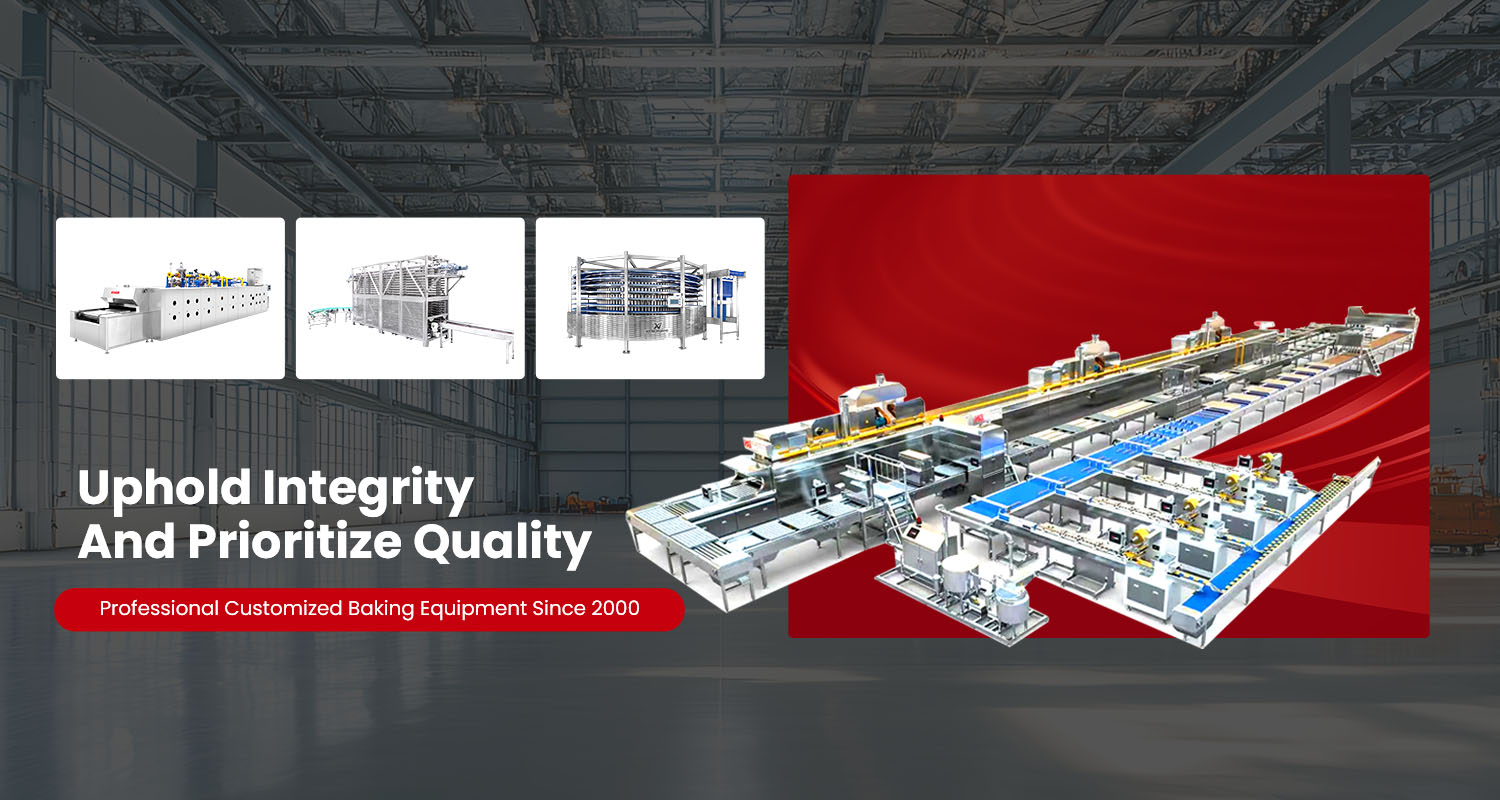
How to Improve Baking Consistency in Factories?
Stable product quality is one of the most critical goals in large-scale bakery production. Differences in color, texture, moisture, or shape across batches not only affect brand reputation but also increase waste and operational costs. Improving industrial baking consistency requires a systematic approach that combines equipment precision, process control, and production discipline. KC-SMART, as an experienced baking equipment manufacturer, focuses on delivering integrated solutions that help factories maintain uniform results at scale.
Raw material standardization and formulation control
Consistency starts before production begins. Variations in flour protein content, moisture level, yeast activity, or fat composition can directly affect dough behavior and final baking results. According to FAO food processing data, raw material variation is one of the primary sources of quality fluctuation in baked goods.
Factories should establish strict supplier standards and implement incoming material inspection protocols. Batch-to-batch verification, controlled storage conditions, and standardized formulation ensure that the base input remains stable. Digital recipe management systems further reduce human error and improve repeatability across shifts.
Precision in mixing and dough development
Mixing determines dough structure, which directly impacts baking performance. Overmixing or undermixing can lead to inconsistent gluten development, affecting volume and crumb texture.
Automated mixing systems with programmable parameters help maintain consistent mixing time, speed, and temperature. Monitoring dough temperature is particularly important, as it influences fermentation behavior and final product quality. Stable mixing conditions provide a reliable foundation for downstream processes.
Fermentation control and process timing
Fermentation is highly sensitive to environmental conditions. Temperature and humidity fluctuations can cause uneven gas production, leading to variation in product size and texture.
Controlled fermentation environments ensure stable proofing results. Integrated systems that coordinate fermentation timing with baking schedules help achieve consistent bread baking by reducing delays and batch overlap. Proper synchronization between fermentation and oven loading prevents under-proofed or over-proofed products from entering the baking stage.
Advanced oven management and heat distribution
The oven is the core of consistency control. Uneven heat distribution, unstable temperature zones, or inconsistent airflow can result in color variation and uneven baking.
A well-designed tunnel oven system control ensures precise temperature regulation across different baking zones. Independent control of top heat, bottom heat, and airflow allows operators to fine-tune the baking profile for different products. Industry studies show that optimized thermal uniformity can reduce product variation by up to 25 percent in continuous baking lines.
Automated temperature monitoring and feedback systems further enhance stability by adjusting parameters in real time.
Automation and process integration
Modern bakeries rely on integrated baking automation system solutions to maintain consistency across high-volume production. Automation reduces dependence on manual adjustments and minimizes human error.
Key benefits of automation include:
synchronized operation between mixing, fermentation, baking, and cooling
real-time monitoring of process parameters
reduced variability between shifts and operators
By connecting each stage of the line, automation ensures that products move through the process under controlled and repeatable conditions.
Cooling and post-baking handling
Consistency does not end when products leave the oven. Cooling plays a crucial role in stabilizing structure and moisture distribution. Uneven cooling can lead to deformation, condensation, or texture differences.
Controlled cooling systems maintain uniform airflow and temperature reduction, ensuring that all products reach packaging conditions at the same rate. Proper handling during slicing and packaging also prevents damage and preserves product appearance.
Data monitoring and quality control systems
Continuous monitoring is essential to control bakery production quality. Sensors and data collection systems allow manufacturers to track key parameters such as temperature, humidity, baking time, and product weight.
Statistical process control methods can identify trends and deviations early, enabling corrective action before defects occur. Historical data analysis also helps optimize production settings for long-term consistency improvement.
Below is an overview of key control points:
| Production Stage | Key Parameter | Consistency Focus |
|---|---|---|
| Raw materials | Composition and moisture | Stable input quality |
| Mixing | Time and temperature | Uniform dough structure |
| Fermentation | Temperature and humidity | Even proofing |
| Baking | Heat distribution | Consistent color and texture |
| Cooling | Airflow and time | Moisture balance |
| Packaging | Handling conditions | Product integrity |
Equipment integration and manufacturer capability
Achieving consistency requires more than individual machines. It depends on how well the entire line is designed and integrated. KC-SMART provides complete bakery processing solutions, ensuring that each stage works in coordination with the others.
With in-house engineering, manufacturing, and installation capabilities, KC-SMART supports customized line configurations that match production requirements. This integrated approach reduces compatibility issues and enhances overall system stability.
Conclusion
Improving baking consistency in factories involves controlling every stage of production, from raw material selection to final packaging. Precision equipment, automation, and data-driven management all contribute to stable and repeatable results. By adopting integrated solutions and focusing on process control, manufacturers can maintain consistent product quality while improving efficiency and reducing waste.