





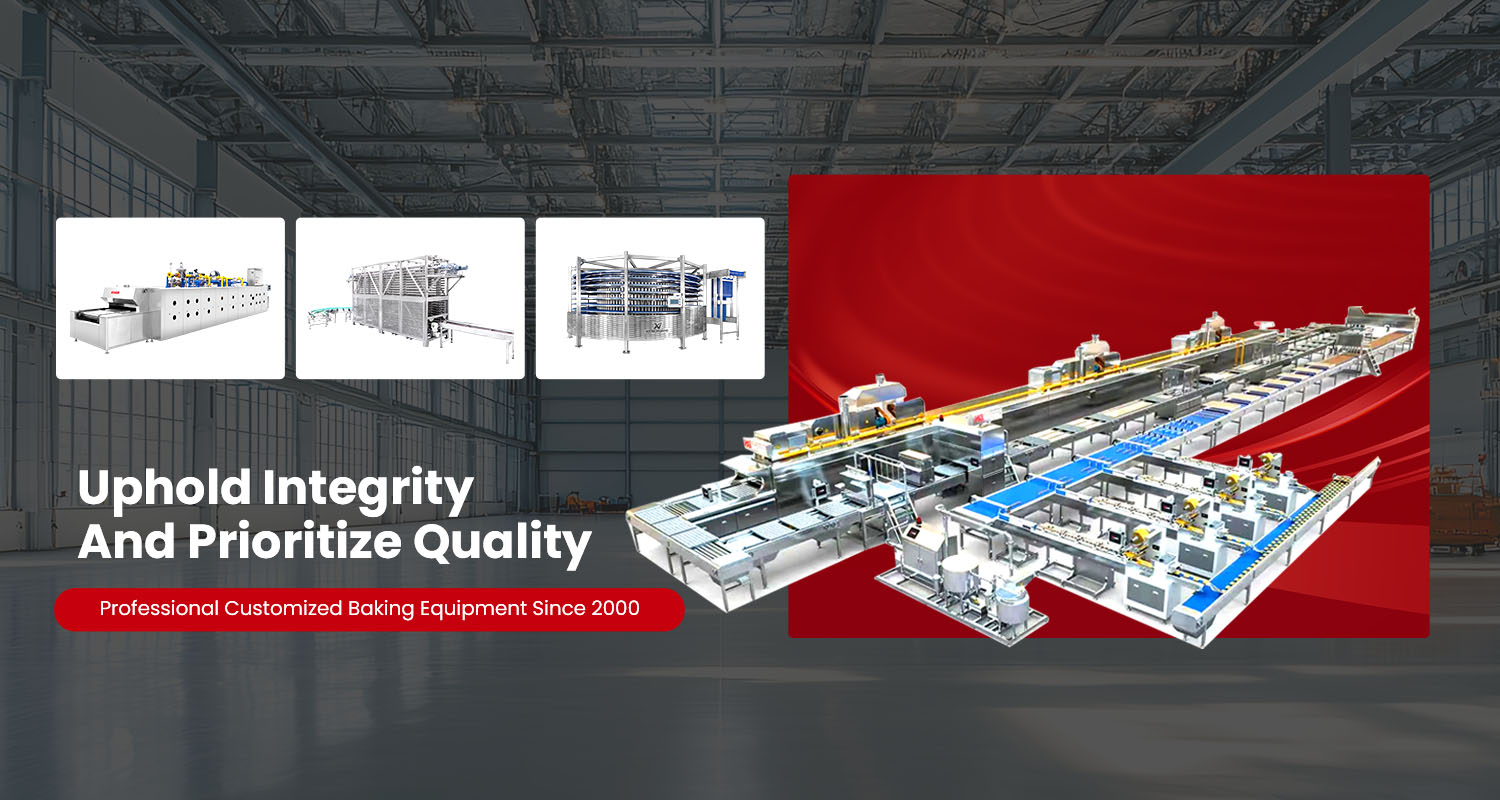
How to Design Efficient Bakery Production Line?
Efficient bakery production is not only about choosing high-performance machines. It depends on how well each stage is connected, how smoothly materials move, and how consistently processes are controlled. A well-executed bakery production line design improves output stability, reduces waste, and supports long-term scalability. KC-SMART focuses on delivering integrated bakery systems that combine engineering planning, equipment manufacturing, and installation support to help factories achieve efficient and reliable operations.
Define product and capacity requirements first
The starting point of any efficient line is a clear understanding of the product range and target output. Bread, cakes, biscuits, and filled products all require different processing conditions, equipment configurations, and production speeds.
Capacity planning should consider peak demand rather than average output. Industry data shows that production lines designed with at least 15 to 20 percent buffer capacity are better able to handle fluctuations without causing bottlenecks. This approach helps maintain stable throughput even during high-demand periods.
Defining these parameters early allows engineers to properly plan bakery production workflow and avoid costly redesigns later.
Optimize layout for smooth material flow
A strong food processing layout ensures that materials move in one direction with minimal backtracking. Raw materials should enter from one side, pass through mixing, forming, fermentation, baking, cooling, and packaging, and exit as finished goods.
Poor layout design often leads to congestion, increased handling, and higher contamination risk. Linear or U-shaped layouts are commonly used in modern bakeries to improve space utilization and reduce travel distance.
Below is a simplified layout comparison:
| Layout Type | Advantage | Limitation |
|---|---|---|
| Linear layout | Simple flow, easy management | Requires longer space |
| U-shaped layout | Compact, efficient movement | More complex planning |
| Multi-level layout | Saves floor space | Higher installation complexity |
Choosing the right layout depends on factory size, product type, and expansion plans.
Balance production capacity across stages
An efficient line requires each stage to operate at compatible speeds. If one section produces faster than another, accumulation or idle time will occur, reducing overall efficiency.
Industrial studies indicate that bottlenecks can reduce total line efficiency by up to 25 percent if not properly managed. Capacity balancing involves matching equipment output, adjusting process timing, and ensuring that transfer systems can handle peak flow.
Integrated industrial line planning helps align all stages, from mixing to packaging, so that products move continuously without interruption.
Select the right equipment configuration
Equipment selection should be based on both performance and compatibility. High-speed machines are only effective when supported by equally capable upstream and downstream systems.
Key considerations include:
mixing systems with stable dough consistency
fermentation equipment with precise temperature and humidity control
baking systems with uniform heat distribution
cooling systems that match production speed
For fermentation, solutions such as a vertical lifting fermentation facility provide efficient use of space while maintaining controlled proofing conditions. This type of equipment supports continuous production and reduces manual handling, improving both efficiency and hygiene.
KC-SMART integrates these components into complete systems, ensuring that each machine operates as part of a unified production line.
Integrate automation and control systems
Automation is essential for maintaining efficiency in large-scale bakery production. Control systems should monitor and adjust key parameters such as temperature, humidity, processing time, and equipment speed.
Automated systems reduce reliance on manual intervention and help design industrial bakery system solutions that are stable and repeatable. Real-time data collection allows operators to identify deviations quickly and make adjustments before they impact product quality.
Automation also supports synchronization between different stages, preventing delays and improving overall throughput.
Plan for hygiene and maintenance access
Efficiency is closely linked to how easily the line can be cleaned and maintained. Equipment should be arranged to allow sufficient space for cleaning, inspection, and repair without disrupting production.
Hygienic design features such as smooth surfaces, accessible components, and minimal dead zones reduce cleaning time and improve sanitation effectiveness. Maintenance-friendly layouts also help reduce downtime and extend equipment lifespan.
Proper zoning between raw material areas and finished product zones further enhances hygiene control and operational efficiency.
Allow flexibility for future expansion
A well-designed production line should not be limited to current needs. Market demand, product variety, and production volume may change over time.
Designing with modular systems and reserved space allows factories to expand capacity or introduce new product lines without major reconstruction. Flexible layouts also support quick changeovers between different products, improving overall production efficiency.
Integrated solutions from KC-SMART
Efficient bakery production line design requires more than individual equipment selection. KC-SMART provides complete solutions that combine process planning, equipment manufacturing, installation, and technical support.
With in-house engineering capabilities and a comprehensive product range, KC-SMART ensures that all components work together seamlessly. This integrated approach reduces compatibility issues and improves long-term operational stability.
Conclusion
Designing an efficient bakery production line involves careful planning of layout, capacity, equipment, and automation. Every stage must be aligned to support continuous and stable production. By focusing on system integration and process optimization, manufacturers can build production lines that deliver consistent quality, high efficiency, and long-term scalability.