





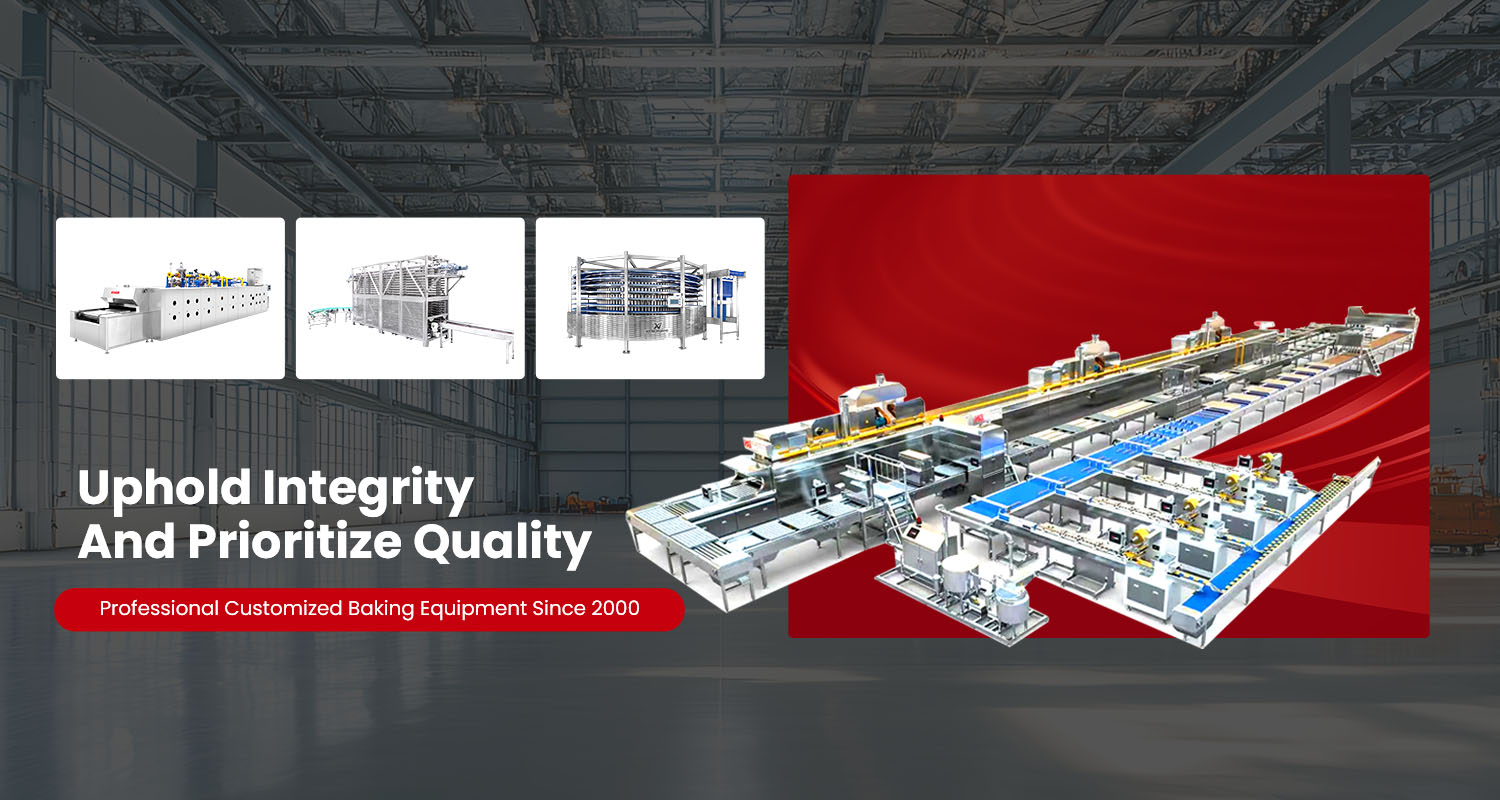
What Is Industrial Baking Line Configuration?
Industrial baking line configuration refers to how bakery equipment, process flow, workshop space, output targets, and product handling methods are arranged into one continuous production system. It is not only about selecting machines. It is about making sure every section can match the next section in speed, capacity, hygiene, and operation logic.
Start From Product Type
Different bakery products need different process routes. Bread, buns, cakes, pastries, cookies, and filled products may look similar from the outside, but their dough condition, forming method, baking time, cooling requirement, and packing rhythm can be very different.
Before choosing equipment, a factory should confirm product size, weight, recipe type, hourly output, and packaging method. These details decide whether the line needs dough dividing, proofing, tunnel baking, spiral cooling, horizontal conveying, automatic sorting, or customized transfer equipment.
Capacity Matching Comes First
A good production line setup should avoid one section running faster than another. If the mixer output is high but the oven capacity is low, dough may wait too long. If the oven is fast but the cooling area is too short, products may enter packing with excess heat.
The line capacity should be calculated from the final product target, then matched backward through each process. This helps reduce repeated adjustment after installation and makes the whole factory easier to manage.
| Line Section | Configuration Focus |
|---|---|
| Mixing | Batch size and dough preparation time |
| Forming | Product shape, weight, and spacing |
| Proofing | Temperature, humidity, and holding time |
| Baking | Heating zones, belt width, and residence time |
| Cooling | Cooling path, airflow, and tower height |
| Packing Connection | Transfer height and product arrangement |
Layout Should Support Real Operation
Bakery system design must consider more than machine placement. Operators need space for cleaning, inspection, mold changing, maintenance, raw material movement, and finished product transfer. A layout that looks compact may become inefficient if people cannot access the machines easily.
Workshop height, column position, drainage, power supply, gas route, air exhaust, and logistics passage all affect the final arrangement. For this reason, design baking system layout work should begin before equipment production, not after machines arrive at the factory.
Process Flow Must Stay Clean
Industrial bakery lines should keep raw material flow, semi-finished product flow, and finished product flow as clear as possible. Crossed movement can increase labor pressure and hygiene risk. Food safety management principles such as HACCP emphasize process control and contamination prevention across the full production chain, which supports careful line planning from the beginning.
A cleaner process flow usually means fewer manual transfer points, clearer inspection positions, and better separation between hot processing, cooling, and packing areas.
How To Configure Bakery Production Line
To configure bakery production line projects properly, the supplier should review both product requirements and factory conditions. KC-SMART usually considers product category, planned capacity, available workshop drawing, energy supply, automation level, cleaning method, and future product expansion.
For a new factory, the line can be planned from raw material input to final packing. For an existing factory upgrade, the design may need to work around current ovens, conveyors, walls, or ceiling height. In both cases, the final goal is the same: stable output with practical operation.
Automation Level Should Be Practical
Not every bakery line needs full automation at the first stage. Some factories may need automatic feeding, dividing, baking, and cooling, while others may keep certain manual steps for flexible product changeover. The right configuration depends on labor cost, product variety, order volume, and investment plan.
Over-automation can make the line expensive and difficult to adjust. Under-automation can increase labor pressure and product variation. A practical configuration should balance efficiency, cost, maintenance, and flexibility.
Final Thoughts
Industrial baking line configuration is the planning work that connects product process, machine capacity, workshop layout, hygiene control, and future production needs. When the configuration is clear, the factory can reduce bottlenecks, improve workflow, and build a more stable baking system.
For bakery manufacturers preparing a new project or upgrading an existing line, early configuration planning helps avoid layout mistakes and makes daily production easier to control.