





How to Improve Bakery Production Stability?
Stable bakery output depends on more than installing machines with high rated capacity. Dough condition, fermentation, baking, cooling, transfer speed, and sorting must remain coordinated. Bakery production stability improves when these variables are measured together and when equipment settings respond predictably to product changes. The goal is to keep variation within limits that protect quality and scheduled output.
Define the Sources of Variation
Production teams should begin by separating material variation from equipment variation. Flour absorption, dough temperature, piece weight, and humidity can change fermentation and baking results. Worn drives, drifting sensors, unstable airflow, and inconsistent conveyor speed create mechanical variation.
Compare planned and actual values at several points in the line. Record dough temperature, proofing time, oven-zone temperature, cooling time, and rejects. This creates a baseline for industrial process control and prevents teams from adjusting several machines at once without knowing which stage caused the deviation.
Connect Each Process Stage
One machine can operate correctly while the complete line remains unstable. A Fermentation Tower may discharge products faster than the oven can receive them, or a cooling section may become congested because the packing area is running slowly. Buffers, transfer logic, and speed coordination should be designed around the full sequence.
To stabilize bakery production line performance, engineers should review:
Product flow from loading to final sorting
Minimum and maximum dwell time at each stage
Conveyor acceleration and deceleration
Upstream and downstream fault communication
Buffer capacity during short interruptions
Recipe changes between product formats
A production consistency system should make these relationships visible. Operators need clear status information, practical alarms, and controlled restarts instead of unrelated panel data.
Use Controls That Support Operators
Automation becomes useful when it simplifies decisions. Recipe storage, synchronized speeds, temperature trends, and alarm history help operators repeat successful settings and spot abnormal conditions earlier. Controls should limit unauthorized changes while allowing approved adjustments.
| Control function | Production purpose | Verification method |
|---|---|---|
| Recipe management | Repeats settings for each product | Compare saved and actual parameters |
| Speed synchronization | Prevents gaps and congestion | Observe transfer spacing under full load |
| Temperature trending | Detects heating drift | Review zone curves across the shift |
| Alarm history | Finds recurring interruptions | Rank alarms by frequency and duration |
| Access levels | Protects critical settings | Test permissions for each operator role |
The objective is to improve system control accuracy without making the interface difficult. Clear units, logical naming, and fault guidance often contribute more to stable operation than adding unnecessary control functions.
Verify Stability Before Scaling Output
Commissioning should test more than basic machine start and stop. The line should run with representative products, realistic loading, and planned changeovers. Teams should confirm temperature recovery, transfer alignment, buffer response, and alarm clarity.
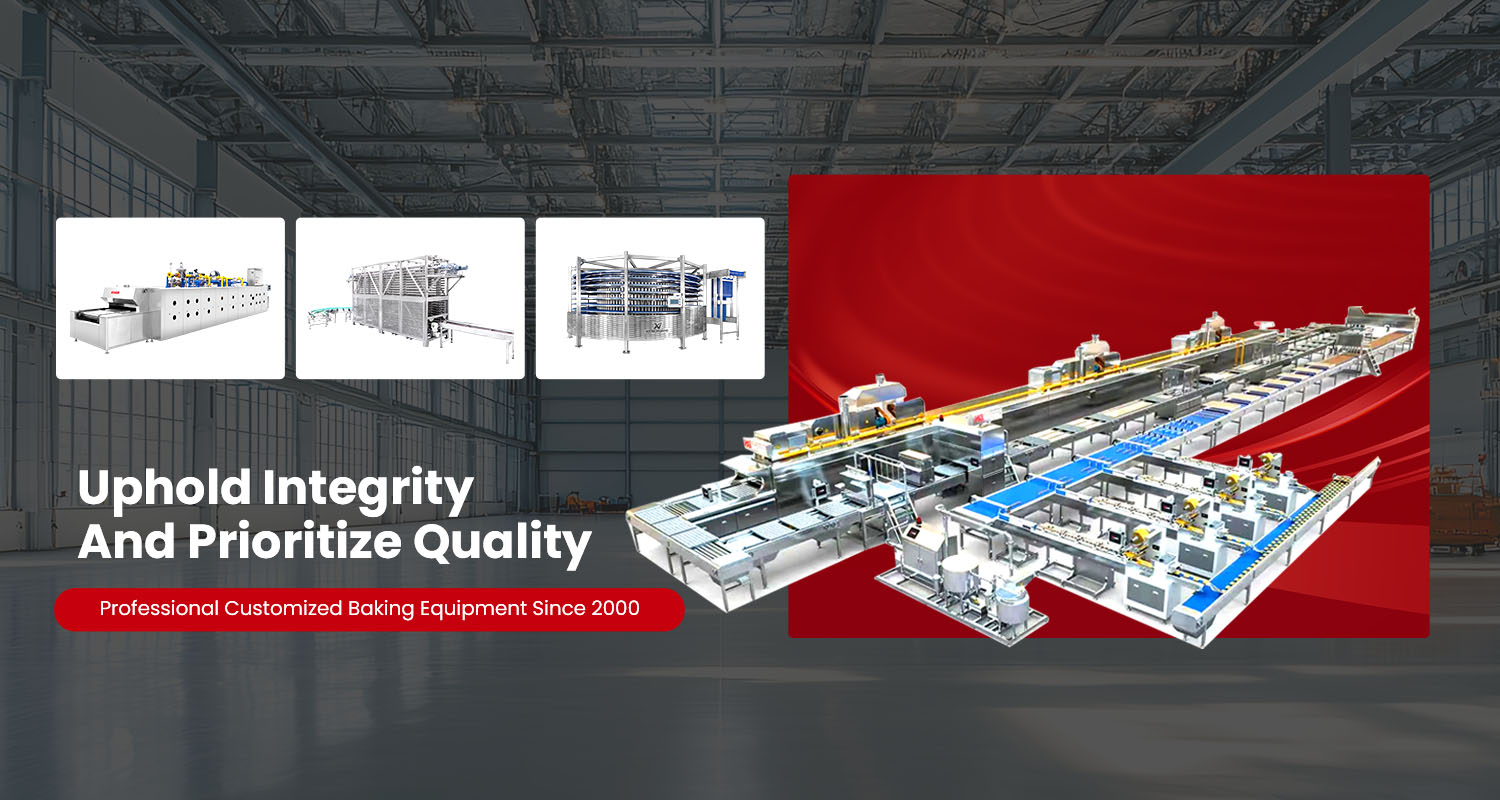
KC-SMART provides customized design, manufacturing, installation, commissioning, and after-sales support. Its equipment covers fermentation, baking, depanning, cooling, and sorting, supporting coordinated line planning.
Long-term stability depends on operating discipline. Standard recipes, calibration schedules, preventive maintenance, shift records, and operator training should be established before output targets are raised. Share product specifications, hourly capacity, process times, and bottlenecks with KC-SMART to develop a repeatable line configuration.