





How to Reduce Production Bottlenecks?
Bottlenecks rarely appear as a permanently stopped machine. More often, they develop through small delays: products wait for space, trays need repositioning, cooling runs long, or downstream equipment pauses. Production bottleneck reduction begins by identifying where flow is restricted, why the restriction changes, and how each correction affects the rest of the bakery line.
Find the Constraint With Real Operating Data
Nameplate capacity is not enough. The true constraint is the stage with the lowest sustainable output under normal operating conditions. Collect cycle time, queue length, stop frequency, reject rate, and labor intervention for each section.
Review feeding, mixing, fermentation, baking, depanning, cooling, sorting, and packaging transfer. A machine may appear slow because the previous stage feeds it irregularly.
Follow a Five-Step Diagnostic Sequence
Observe the full shift. Include startup, normal running, product changes, cleaning, and restart.
Measure waiting and blocking. Waiting means a machine lacks products; blocking means it cannot discharge them.
Rank losses by duration. Frequent micro-stops often create more lost time than rare breakdowns.
Confirm the root cause. Check whether the problem comes from equipment, product variation, staffing, or control logic.
Retest after correction. Removing one constraint may expose another stage as the new limit.
This workflow optimization system prevents investment in the wrong machine or speed increases that add no usable capacity.
Separate Capacity Problems From Stability Problems
A stage may have enough theoretical capacity but still restrict output through faults, slow recovery, or poor handling. Before buying larger equipment, compare maximum and stable speed. The gap often reveals maintenance, setup, or synchronization issues.
Common signs include:
An oven repeatedly waiting for proofed products
Cooling conveyors filling after short packaging stops
Depanning interruptions caused by tray or product variation
Sorting lanes receiving uneven loads
Long recovery after cleaning or recipe changes
Correcting these conditions can improve production flow efficiency without increasing nominal machine speed.
Use Buffers With a Defined Purpose
Buffers can absorb short differences between stages but should not hide permanent imbalance. Too little accumulation causes a complete line stop after a minor interruption. Too much accumulation increases floor-space use, product waiting time, and traceability complexity.
Define interruption length, product tolerance, available space, and first-in-first-out flow. Soft or warm products may need gentle handling and limited accumulation.
Improve Controls Between Machines
Independent machines can run efficiently on their own while the complete line performs poorly. Shared signals should communicate ready, running, blocked, fault, and speed status. This lets upstream sections respond before products jam.
An industrial efficiency improvement plan should simplify alarms. Operators need to know the stop source, affected stages, and safe restart sequence.
Eliminate Bakery Bottlenecks Through Line-Level Design
The goal to eliminate bakery bottlenecks does not mean removing every pause. Planned sanitation, inspection, and maintenance are necessary. The goal is to remove avoidable waiting while keeping sufficient time for fermentation, baking, cooling, and product protection.
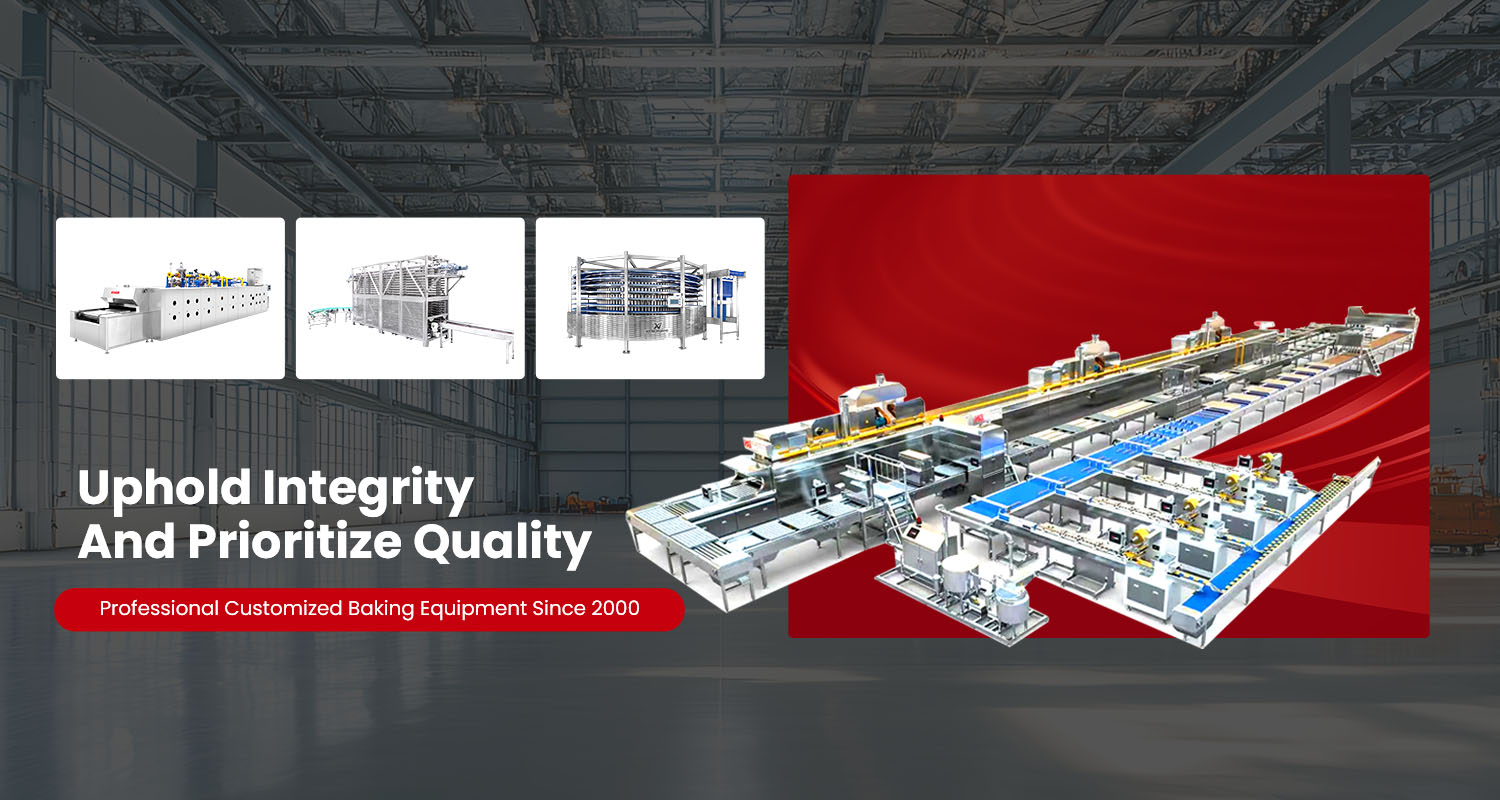
KC-SMART offers equipment for dough handling, fermentation, tunnel baking, depanning, spiral cooling, automatic sorting, and supporting transport. Its one-stop approach covers customized design, manufacturing, installation, commissioning, and after-sales maintenance, supporting coordinated line planning.
Useful inputs include product type, hourly target, process times, tray dimensions, floor plan, shift pattern, labor, and stop records. With these inputs, engineers can locate the actual constraint, balance connected stages, and support future expansion.