





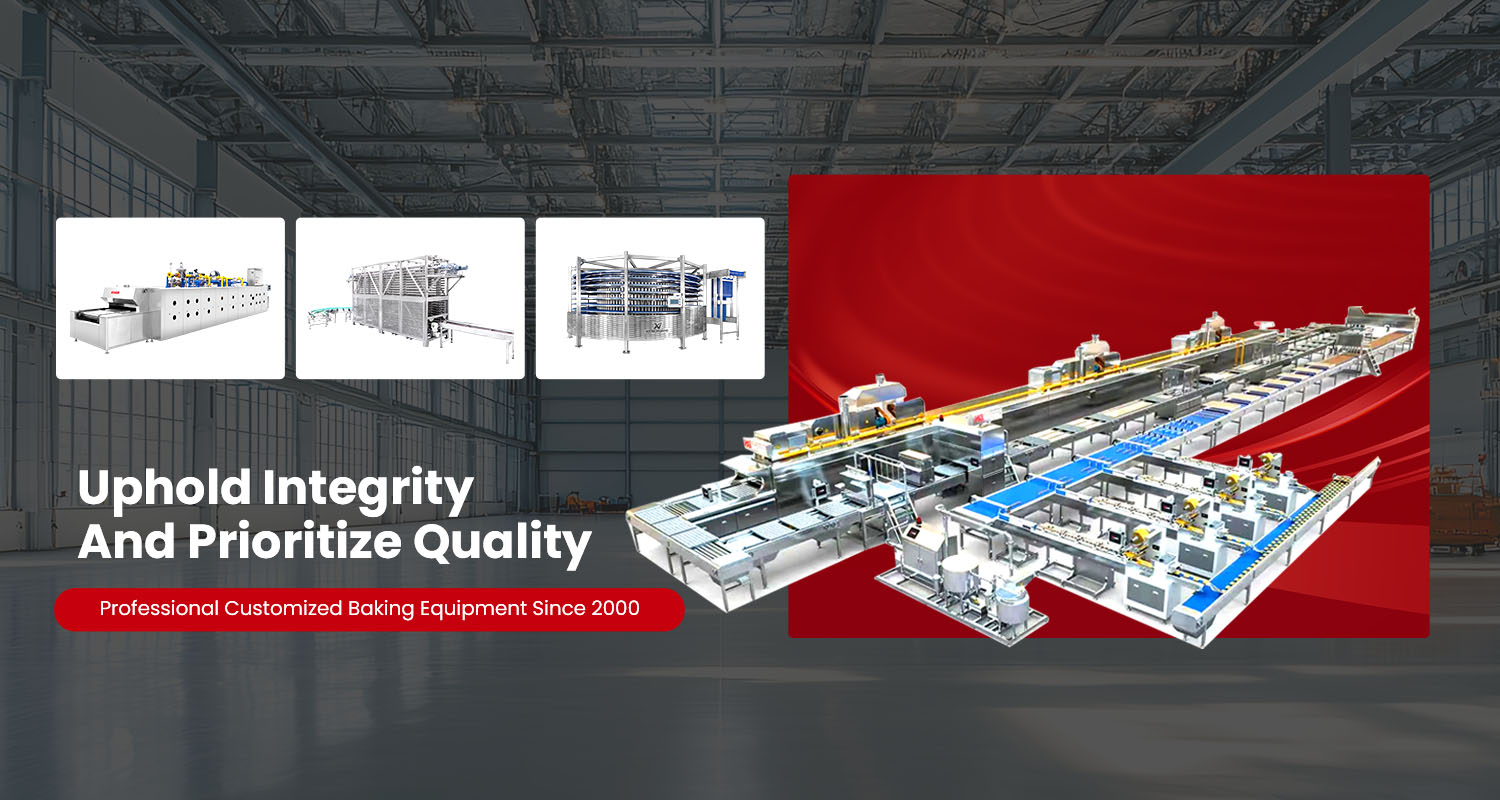
What Is Spiral Cooling Conveyor System?
Cooling is a controlled production stage that protects product structure and prepares baked goods for handling or packing. A spiral cooling conveyor moves products through a long conveying path arranged vertically around a central structure. This design provides extended cooling time while using less floor area than a straight conveyor of similar length.
Basic Working Principle
Products enter the spiral at a defined speed and travel upward or downward through multiple levels. Heat is released to surrounding or conditioned air. The conveyor then discharges products at the required temperature.
The equipment is normally connected after an oven or Depanning Machine. Its speed must match baking output so products do not accumulate at the inlet or leave too quickly.
Why Vertical Conveying Is Used
Many breads, cakes, and pastries require a long cooling path. Installing the same path in a straight line may consume excessive floor space. Vertical movement allows the factory to use building height more effectively.
Main benefits include:
Longer dwell time within a compact footprint
Continuous movement without tray storage
Flexible inlet and outlet elevations
Easier connection between production levels
Stable flow toward sorting or packing
This is useful where output is high and floor area is limited.
Key Design Parameters
A spiral cooling system for bakery production should be calculated from actual process data:
Product dimensions and weight
Required cooling time
Inlet and discharge temperature
Hourly quantity and loading pattern
Belt width and usable loading area
Building height and available footprint
Upstream and downstream speeds
An incorrect dwell time can send warm products to packing or cause unnecessary cooling.
Airflow and Cooling Conditions
The conveyor provides travel time, but cooling also depends on airflow, room temperature, humidity, and spacing. Products placed too close together may block air movement, while uneven airflow can create temperature differences across the belt.
| Cooling factor | Possible problem | Response |
|---|---|---|
| Irregular spacing | Uneven heat release | Stabilize loading before entry |
| High room temperature | Slow cooling | Review ventilation or conditioned air |
| Excess humidity | Surface moisture | Control the environment |
| Product overlap | Deformation | Improve guides and feed timing |
| Unstable belt speed | Variable dwell time | Synchronize line speed |
Industrial cooling line design must therefore consider both conveying and environmental control.
Product Handling and Belt Selection
Bakery cooling equipment should support products without leaving marks or deformation. Belt material, opening size, transfer height, and turning radius must suit the product. Soft cakes need gentle transfers, while small products need openings that prevent tipping. Product trials help confirm the configuration.
Hygiene and Maintenance Access
Crumbs and residue can collect on belts and lower levels. Collection trays, accessible return sections, removable guards, and clear procedures support sanitation. Enclosed systems also need access to filters, fans, ducts, and drainage points.
Integration With the Line
Spiral speed should communicate with baking, sorting, and packing equipment. A short downstream stop should not immediately create congestion inside the cooler. Controlled accumulation and coordinated restart logic help maintain order.
A system designed to improve cooling efficiency must still protect the required dwell time. Increasing belt speed may raise output but reduce cooling, so temperature and texture should be checked after every capacity change.
KC-SMART designs bakery systems that include spiral and vertical cooling equipment, tunnel ovens, fermentation systems, depanning machines, and sorting lines. Product samples, temperature data, capacity targets, layout drawings, and sanitation requirements provide the basis for a stable cooling configuration.