





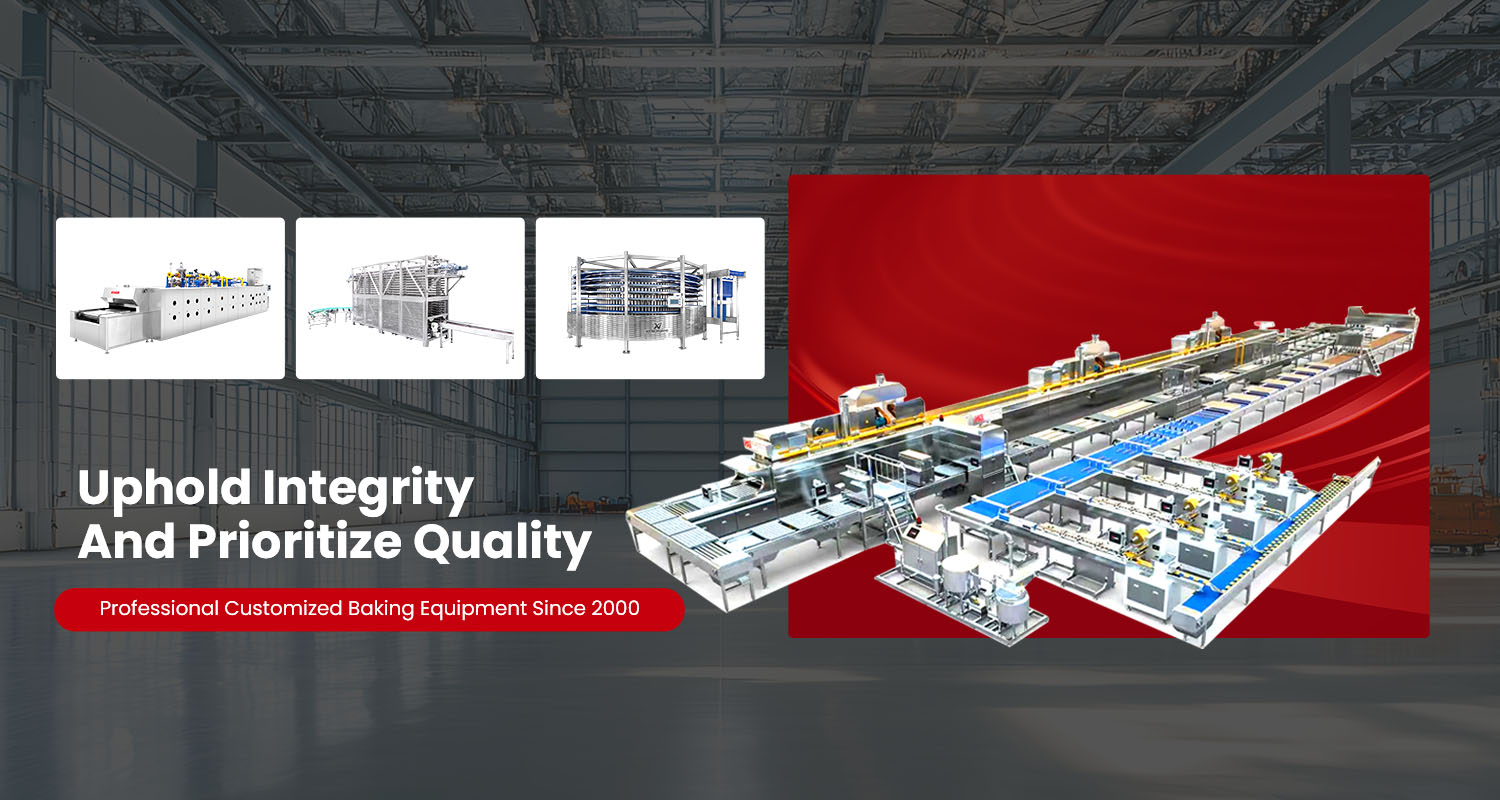
How to Select Bakery Production Line?
Production line selection should begin with the product and process, not with a list of machines. A bakery production line must convert ingredients into finished goods at the required quality, output, and cost while fitting the factory layout. The correct solution balances mixing, forming, proofing, baking, cooling, depanning, sorting, and packing instead of maximizing one isolated machine.
Define the Product Portfolio
Bread, buns, cakes, pastries, and cookies vary in dough behavior, baking profile, cooling time, and handling strength. Factories should define immediate and future products.
Useful information includes dimensions, unit weight, recipe range, tray type, filling, surface finish, and daily volume. This helps engineers decide whether one flexible line can cover several products.
Calculate Sustainable Capacity
Rated capacity should not be confused with usable output. Warm-up, cleaning, recipe changes, maintenance, and short interruptions reduce production time. Planning should use sustainable speed and include the slowest process stage.
| Planning item | Question to confirm | Effect on design |
|---|---|---|
| Hourly output | What volume is required? | Machine size and conveyor speed |
| Shift pattern | How long will the line run? | Duty level and maintenance plan |
| Product change | How often will formats change? | Adjustment and recipe functions |
| Cooling time | When is packing safe? | Cooling length or spiral size |
| Space limit | What area and height are available? | Layout and access |
This prevents an industrial baking system from being oversized in one area and restricted in another.
Review the Full Process Route
A complete baking line solution should show every transfer from preparation to packing. Poor connections can create deformation, overlap, tray jams, or irregular spacing.
The process review should cover mixing, forming, proofing conditions, oven profile, depanning method, cooling duration, sorting, and packaging feed. Each stage must support the required product quality and line capacity.
Check Factory Conditions
The line must fit the building, utilities, and hygiene plan. Engineers need ceiling height, floor loading, drainage, gas, electricity, compressed air, and ventilation data. Operators also need safe access for cleaning, maintenance, and changeover.
Match Automation With Labor
Automation should solve a defined production problem. Factories should identify where labor is used, which tasks create inconsistency, and where handling may damage products.
When teams choose bakery production equipment, they should review recipe management, alarm records, speed coordination, and operator access. More functions are not automatically better. Controls should be clear for operators and detailed enough for fault diagnosis.
Review Hygiene and Maintenance
Food-contact areas should use suitable materials and support practical cleaning. Maintenance planning should cover wear parts, lubrication, sensor access, spare-part recommendations, and service intervals. The food processing line should allow inspection without excessive dismantling.
Evaluate Engineering Support
Machine delivery is only one part of the project. Layout design, process confirmation, installation, commissioning, training, and after-sales support influence the start of stable production.
The manufacturer should ask detailed questions about products, output, plant conditions, and operating methods. Technical proposals should explain assumptions clearly.
Allow for Expansion
Expansion may involve higher output, new sizes, more lanes, or additional packaging machines. Reserving space, control interfaces, and transfer points can reduce future reconstruction.
KC-SMART provides customized bakery systems covering fermentation, tunnel baking, depanning, cooling, conveying, and automatic sorting. Product samples, target capacity, factory drawings, and future plans give engineers the information needed to develop a practical line configuration.