





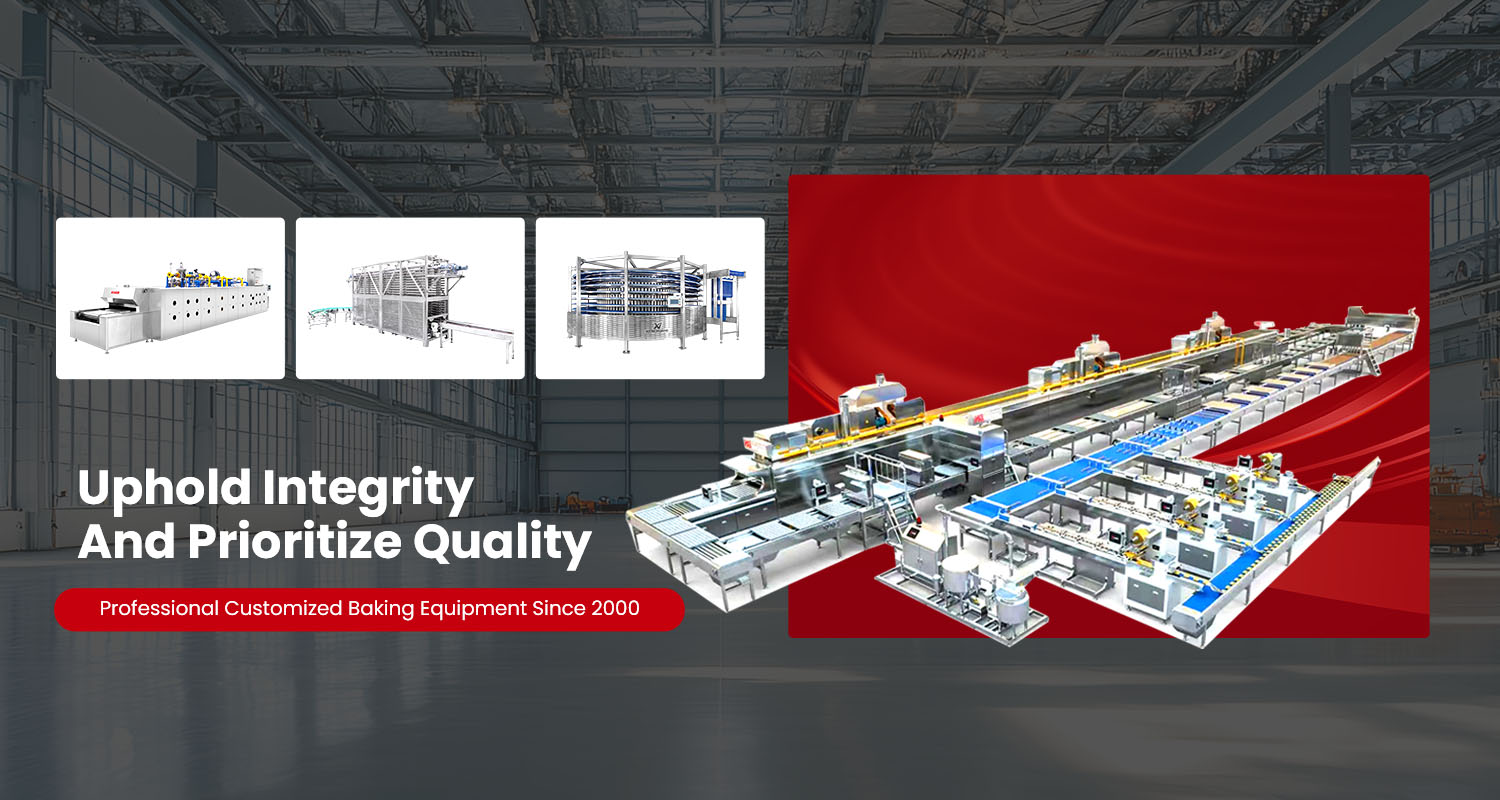
How To Reduce Bread Cooling Time With Spiral Cooling Equipment?
Bread cooling is an essential stage between baking and packaging, but it can also become a production bottleneck. Freshly baked bread contains substantial internal heat and moisture. If products are packaged before reaching a suitable temperature, condensation may form inside the packaging, affecting crust texture and product storage stability. However, extending cooling time unnecessarily increases work-in-process inventory and may limit the output of the entire bakery line.
Spiral Cooling Tower Equipment helps manufacturers manage this challenge by providing a continuous conveying path and controlled airflow within a relatively compact structure. Reducing cooling time does not simply mean increasing fan speed or shortening the conveyor route. The objective is to improve heat transfer while maintaining product quality, consistent discharge temperatures, and stable production flow.
1. Understand What Determines Bread Cooling Time
Several factors influence how quickly bread releases heat after baking:
Product thickness: Larger loaves generally require more time for internal heat to reach the surface.
Initial temperature: Higher oven discharge temperatures increase the heat that must be removed.
Moisture content: Water content influences thermal behavior and moisture evaporation.
Air temperature: Cooler surrounding air can increase the temperature difference driving heat transfer.
Air velocity: Suitable airflow helps remove warm air surrounding products.
Product spacing: Adequate gaps allow cooling air to reach more product surfaces.
These variables should be evaluated together before modifying cooling equipment.
2. Improve Airflow Distribution Inside the Tower
Air circulation is one of the most important factors affecting cooling performance.
When airflow is uneven, some products may cool quickly while others remain warm. Increasing overall fan output may not solve this problem if certain areas receive insufficient air.
A better approach includes:
Reviewing airflow distribution across different conveyor levels.
Identifying areas where warm air accumulates.
Adjusting air inlet and outlet arrangements.
Checking whether conveyor loading blocks air circulation.
Measuring product temperatures at different discharge positions.
Uniform airflow helps improve cooling consistency without unnecessarily increasing energy consumption.
3. Optimize Conveyor Loading and Product Spacing
Overloading a spiral conveyor can reduce cooling efficiency. Products placed too closely together may restrict air movement and create uneven temperature distribution.
Manufacturers should establish suitable product spacing according to bread dimensions and cooling requirements.
For example, larger loaves may require wider spacing than small buns. The loading arrangement should also prevent products from touching tower structures or interfering with conveyor movement.
4. Match Cooling Capacity With Production Output
The cooling system must handle the output of the upstream oven without creating accumulation.
A basic capacity relationship is:
Required Cooling Capacity = Production Output per Hour × Cooling Time / 60
For example, a bakery producing 2,400 loaves per hour with a target cooling residence time of 30 minutes needs space for approximately 1,200 loaves inside the cooling system.
This calculation provides an initial reference. Actual capacity also depends on belt width, product spacing, tower layers, and conveyor configuration.
5. Compare Cooling Improvement Methods
| Improvement Method | Expected Benefit | Important Consideration |
|---|---|---|
| Airflow optimization | More uniform heat removal | Avoid excessive surface drying |
| Better product spacing | Improved air circulation | Maintain conveyor capacity |
| Conveyor speed adjustment | Controls residence time | Verify internal temperature |
| Tower insulation | Reduces external heat influence | Check operating environment |
| Temperature monitoring | Identifies cooling variations | Use representative measurement points |
These adjustments should be validated through production testing rather than applied independently.
6. Use Temperature Testing to Confirm Results
A lower surface temperature does not necessarily mean the bread has cooled sufficiently internally.
Manufacturers should measure product temperatures at representative locations, including the center of larger loaves. Testing should cover different tower levels and production conditions.
The cooling process can then be adjusted according to actual discharge temperature, product texture, and packaging requirements.
KC-SMART considers conveyor configuration, cooling performance, and downstream packaging requirements when planning bakery production equipment.
7. Avoid Reducing Cooling Time at the Expense of Product Quality
Excessively aggressive cooling may cause unwanted moisture loss, surface drying, or product texture changes. The correct target is the shortest cooling time that still achieves the required product condition.
Manufacturers should also maintain consistent oven output, product spacing, and conveyor loading to prevent fluctuations in cooling performance.
Conclusion
Reducing bread cooling time requires coordinated improvements in airflow, product spacing, conveyor speed, and cooling capacity. spiral cooling tower Equipment provides a continuous cooling path, but its performance depends on matching equipment settings with actual bread characteristics and production requirements. Measuring internal product temperature and verifying packaging conditions are essential steps toward achieving faster and more consistent bakery production.