





How Does A Spiral Cooling Tower Save Space In Bakery Factories?
Industrial bakeries need sufficient cooling capacity between oven discharge and product packaging. As production output increases, the required cooling conveyor length also grows. Traditional horizontal cooling arrangements may occupy considerable floor space, creating difficulties when factories need to accommodate additional processing machines, material storage, or packaging operations.
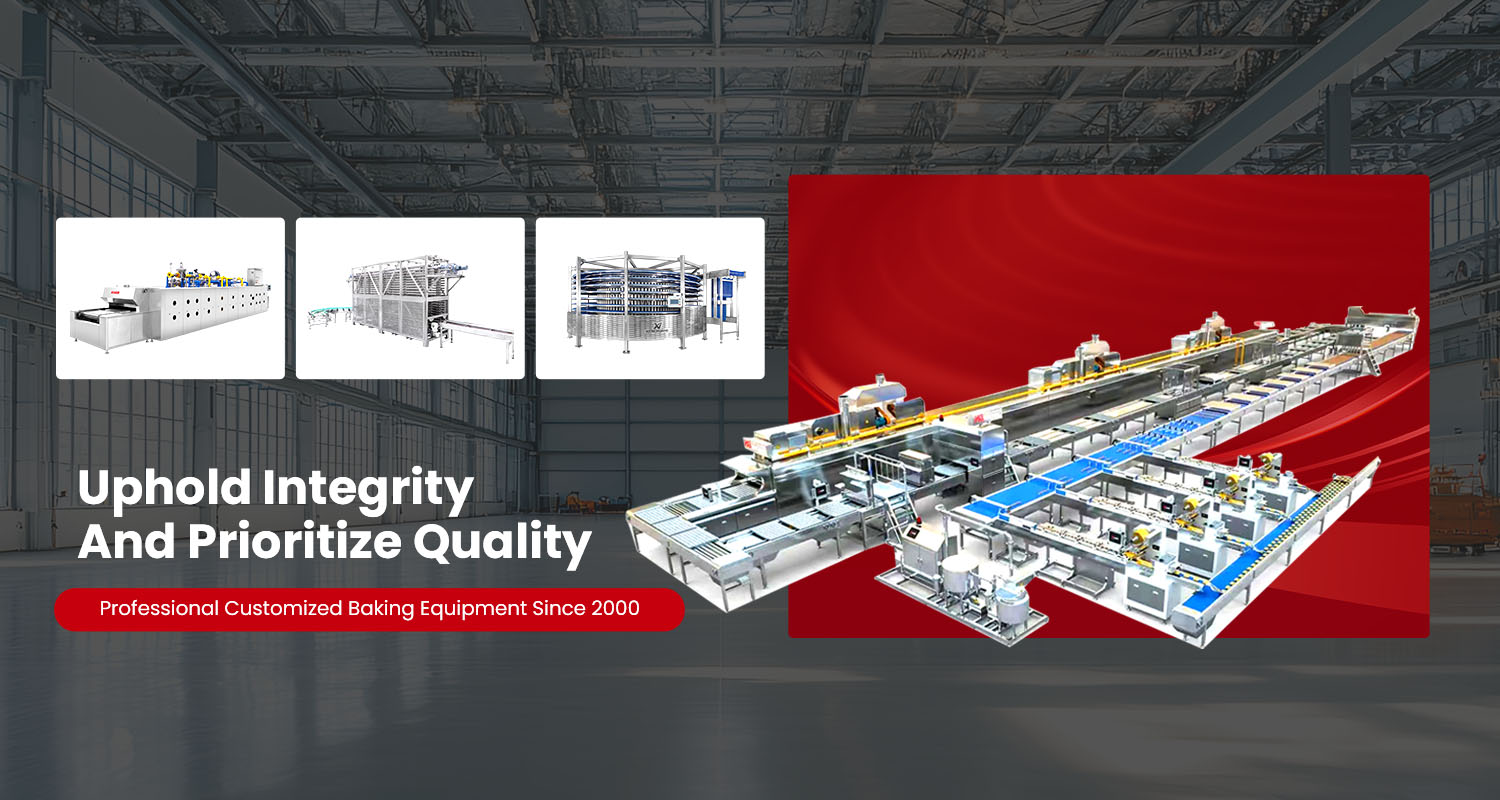
Spiral Cooling Tower Equipment provides an alternative by arranging a long conveying path vertically rather than spreading it across the factory floor. Products travel through multiple spiral levels while cooling air circulates around them. This structure allows manufacturers to achieve the required cooling residence time within a relatively compact installation area.
1. Replace Long Horizontal Conveyors With Vertical Conveying
The main space-saving principle is the use of vertical height.
A conventional horizontal cooling conveyor requires a long route to provide sufficient product residence time. A spiral tower folds this conveying path into multiple levels arranged around a central structure.
The difference can be understood through the following comparison:
Horizontal Cooling Arrangement
Requires considerable floor length.
May interfere with other production activities.
Can create longer material transfer routes.
Becomes difficult to expand in restricted factory layouts.
Spiral Cooling Arrangement
Uses available vertical factory space.
Provides a long continuous conveying route.
Reduces the horizontal footprint.
Can connect directly with oven and packaging conveyors.
The actual space advantage depends on tower dimensions, required capacity, and building height.
2. How Much Conveying Length Can Be Arranged Vertically?
A spiral structure distributes the conveyor across multiple levels. The effective conveying length depends on the number of turns, tower diameter, and belt configuration.
For a simplified circular path:
Conveyor Length per Turn = π × Average Conveyor Path Diameter
If the average conveying path diameter is 4 meters, one complete turn provides approximately 12.57 meters of conveyor length.
With multiple levels, the total conveying path increases substantially without requiring an equally long horizontal installation area.
Actual equipment geometry may differ according to the spiral structure and mechanical design.
3. Why Is This Structure Useful for Industrial Bakeries?
The vertical arrangement offers several operational advantages beyond reducing floor space.
| Production Requirement | Spiral Tower Contribution |
|---|---|
| Limited floor area | Uses available building height |
| Continuous cooling | Provides a long conveying route |
| High production output | Supports multi-level product transportation |
| Automated handling | Connects with upstream and downstream conveyors |
| Factory layout | Reduces the need for long horizontal routes |
This arrangement is particularly useful for bread, buns, rolls, and other baked products that require controlled cooling before packaging.
4. Important Space Planning Considerations
A compact footprint does not mean the tower can be installed anywhere. Manufacturers must evaluate the complete operating environment.
Factory ceiling height: Confirm sufficient clearance for the tower structure, installation, and maintenance.
Equipment connections: Check the positions of oven discharge and packaging infeed conveyors.
Maintenance access: Reserve sufficient space for cleaning, belt inspection, and drive system maintenance.
Material movement: Avoid unnecessary changes in product direction that may affect transfer stability.
Air circulation: Ensure the surrounding factory layout does not obstruct cooling airflow.
5. Balance Space Savings With Cooling Capacity
Reducing the tower footprint should never compromise the required cooling performance.
Manufacturers need to calculate the necessary product holding capacity before confirming the tower dimensions.
Required Holding Capacity = Hourly Production Output × Cooling Time / 60
For example, a bakery producing 3,000 products per hour with a cooling residence time of 25 minutes needs space for approximately 1,250 products inside the cooling system.
The final design must also account for product spacing, belt width, airflow, and discharge temperature.
6. Plan the Complete Bakery Production Layout
A spiral cooling tower should be considered part of the complete production line rather than an isolated machine. Its infeed and discharge positions must match the oven and packaging equipment.
KC-SMART considers factory layout, conveying requirements, cooling capacity, and equipment connections when evaluating spiral cooling solutions.
A suitable design should provide enough space for daily operation, cleaning, maintenance, and future production adjustments.
Conclusion
A spiral cooling tower saves space by arranging a long continuous conveyor path across multiple vertical levels instead of extending it horizontally across the factory. This makes better use of available building height while supporting continuous bakery cooling. However, successful installation still requires careful evaluation of cooling capacity, ceiling clearance, equipment connections, and maintenance access.