





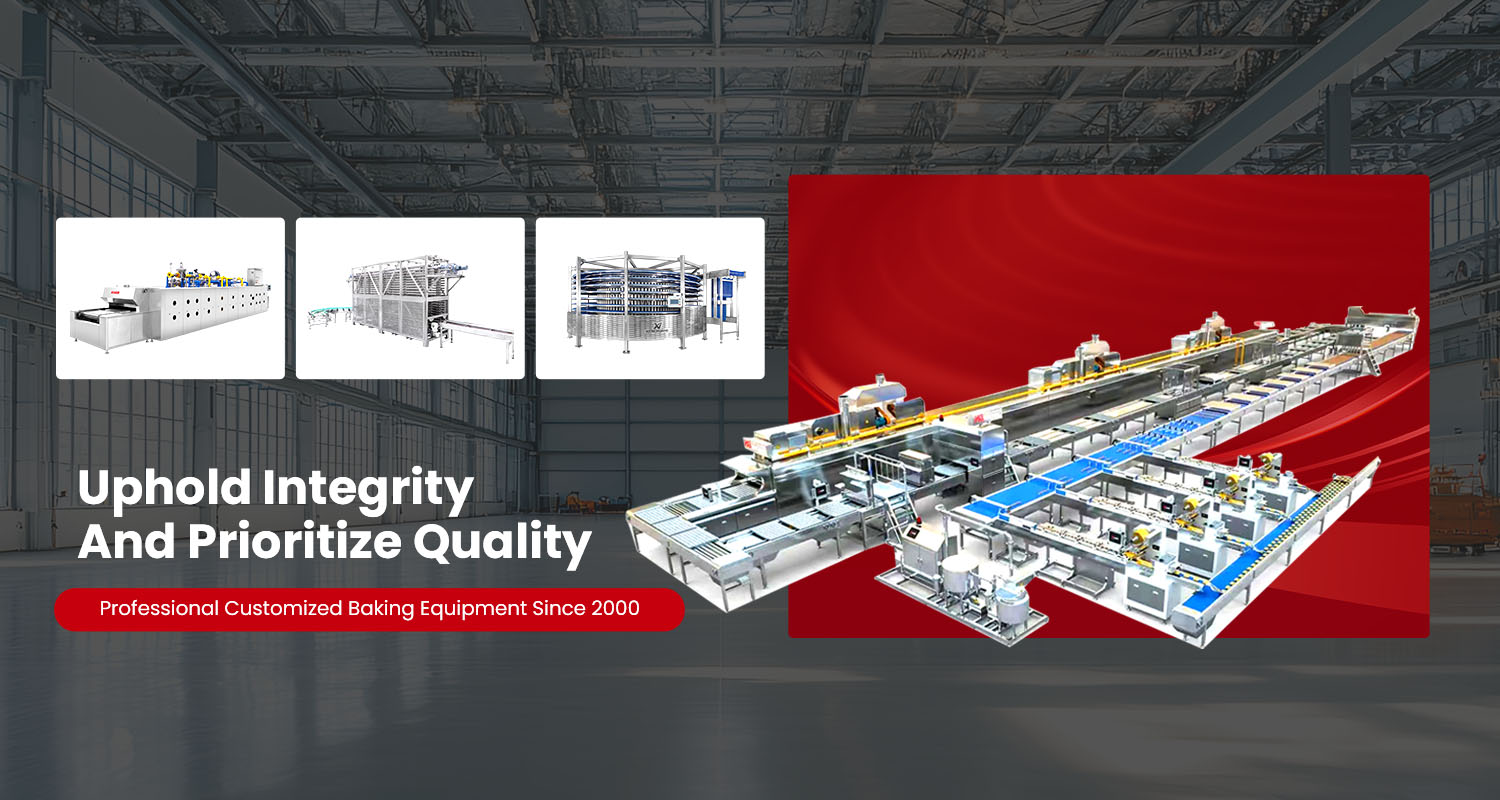
How To Choose Bakery Equipment For High Volume Production?
High-volume bakery production requires more than purchasing machines with high individual output capacities. Every stage, from ingredient preparation and dough mixing to dividing, shaping, fermentation, baking, cooling, and packaging, must operate at a compatible speed. If one machine cannot keep up with the others, unfinished products will accumulate, equipment will remain idle, and the entire production line may experience delays.
Selecting Industrial bakery equipment therefore requires a complete understanding of production targets, product specifications, factory layout, and process integration. Manufacturers should evaluate equipment as part of a connected production system rather than comparing machines independently. The right configuration should support continuous operation, consistent product quality, and manageable maintenance requirements.
1. Start With Your Actual Production Requirements
Before requesting equipment quotations, establish the expected production capacity and product range.
For example, a factory producing 5,000 bread rolls per hour has different requirements from one manufacturing 5,000 large loaves. Product dimensions, dough weight, processing time, and cooling requirements all influence machine configuration.
Consider this information:
| Production Information | Why It Matters |
|---|---|
| Hourly output | Determines machine capacity |
| Product dimensions | Influences processing configuration |
| Dough weight | Affects dividing and shaping equipment |
| Product variety | Determines changeover requirements |
| Working hours | Influences operating schedules |
| Factory layout | Determines equipment arrangement |
Capacity should be calculated using actual finished-product output, not theoretical machine speed alone.
2. Match Every Production Stage
A high-volume bakery line normally contains several connected processes. Each stage must provide sufficient capacity for the next operation.
Dough preparation: Mixers must handle the required batch size and supply dough consistently to downstream equipment.
Dividing and shaping: These machines determine portion accuracy, product dimensions, and the consistency of dough handling.
Fermentation: Proofing equipment must accommodate the required residence time without restricting upstream output.
Baking: Oven capacity, heating uniformity, and conveyor speed must match the product specifications.
Cooling and packaging: Cooling equipment needs sufficient conveying capacity to prevent product accumulation before packaging.
For example, increasing oven output without upgrading the cooling section may simply move the bottleneck further down the production line.
3. Calculate the Real Production Capacity
A useful starting point is to calculate the capacity required at each processing stage.
Required Hourly Output = Daily Production Target / Daily Operating Hours
If a factory needs 36,000 finished products during an 8-hour shift, its average target is 4,500 products per hour.
Manufacturers should also consider changeovers, cleaning, maintenance, and unexpected interruptions. Equipment should not be selected solely on the assumption that it will operate at maximum capacity throughout the entire shift.
4. Evaluate Automation and Equipment Integration
High-volume production benefits from coordinated material handling and automatic process control. Automatic feeders, transfer conveyors, PLC systems, and synchronized drives help maintain a stable production rhythm.
When evaluating equipment integration, examine:
Whether upstream and downstream machines can communicate.
Whether product transfers require manual intervention.
Whether processing speeds can be synchronized.
Whether abnormal conditions trigger appropriate alarms.
Whether operators can access key components for maintenance.
A commercial bakery machinery supplier should understand these integration requirements before finalizing the production layout.
5. Consider Long-Term Operating Costs
The initial purchase price does not represent the complete cost of bakery equipment. Energy consumption, spare parts, maintenance labor, cleaning time, and production losses all influence long-term operating expenses.
For high-volume factories, even small differences in daily operating efficiency can accumulate into significant costs over time.
KC-SMART considers production capacity, process compatibility, and equipment configuration when evaluating industrial bakery machinery requirements.
Conclusion
Choosing bakery equipment for high-volume production requires balancing processing capacity, product quality, automation, and operating costs. Manufacturers should identify potential bottlenecks across the complete workflow and verify that each machine can support the required output. A properly planned industrial bakery equipment configuration provides a more reliable foundation for continuous production and future capacity expansion.
Previous:
Next: How Does A Spiral Cooling Tower Save Space In Bakery Factories?