





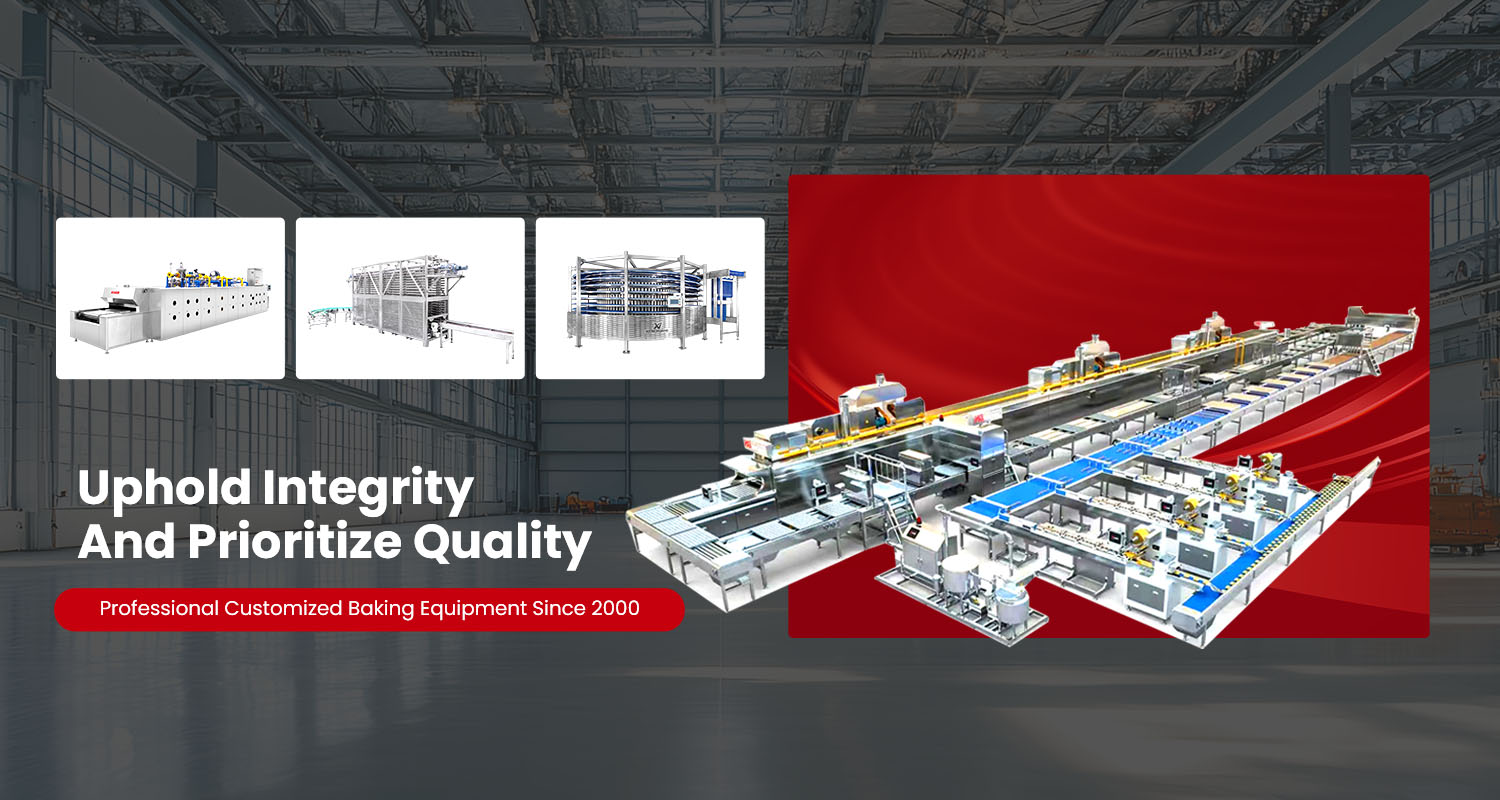
How To Expand Bread Production Capacity Efficiently?
Expanding bread production capacity is not simply a matter of purchasing additional machines or increasing operating hours. As order volumes grow, existing equipment may struggle to maintain consistent output, especially when mixing, dividing, shaping, fermentation, baking, cooling, and packaging operate at different speeds. Increasing the capacity of only one section can create new bottlenecks elsewhere and lead to unnecessary equipment investment.
A successful Bakery Production Line expansion plan should begin with an evaluation of current production performance. Manufacturers need to identify where output is restricted, determine which processes require upgrades, and establish how new equipment can connect with existing machinery. The objective is to increase finished-product output while maintaining product quality, production stability, and manageable operating costs.
1. Identify the Actual Production Bottleneck
Before expanding equipment capacity, examine the output of every production stage. A bakery may have sufficient mixing capacity but insufficient dividing or cooling capacity. In this situation, purchasing another mixer will not significantly increase finished-product output.
Consider a simplified production line:
Mixing → Dividing → Shaping → Fermentation → Baking → Cooling → Packaging
Each stage must support the required production rate. The slowest operation often determines the practical output of the complete line.
Manufacturers should collect production records covering hourly output, equipment downtime, changeover duration, product rejection rates, and material accumulation between workstations. These figures provide a realistic starting point for expansion planning.
2. Compare Existing Capacity With Future Demand
Production expansion should account for expected order growth rather than temporary increases in demand.
For example, if current daily output is 20,000 loaves and the target is 30,000, the required capacity increase is 50%.
Capacity Increase = (Target Output - Current Output) / Current Output × 100%
However, manufacturers should also consider product variety, working shifts, maintenance schedules, and seasonal demand. Equipment selected only for today's production volume may become restrictive again after a short period.
3. Choose the Right Expansion Strategy
There are three common approaches to increasing bakery capacity.
Upgrade existing equipment
Replacing key components, improving feeding systems, or optimizing machine controls may increase output without changing the entire production layout. This approach is suitable when existing equipment still has sufficient mechanical capacity.
Add parallel production equipment
Installing additional dividing, shaping, or processing machines can increase capacity at specific bottlenecks. However, upstream and downstream equipment must also accommodate the additional output.
Build an integrated production line
For larger expansion projects, a new automated line may provide better coordination between processing stages. Automatic feeding, synchronized conveyors, and centralized control can reduce unnecessary handling and improve production continuity.
4. Which Equipment Sections Should Be Upgraded First?
| Production Stage | Possible Upgrade | Expected Benefit |
|---|---|---|
| Dough mixing | Larger or additional mixers | Increased batch capacity |
| Dividing | Automatic high-capacity divider | Faster portioning |
| Shaping | Automated moulding equipment | Consistent processing |
| Fermentation | Larger Fermentation Tower | Greater holding capacity |
| Baking | Additional or higher-capacity oven | Increased baking output |
| Cooling | spiral cooling system | Continuous product cooling |
| Packaging | Automatic packaging equipment | Reduced downstream delays |
The priority should depend on measured bottlenecks rather than the apparent importance of individual machines.
5. Improve Automation Before Expanding Floor Space
Sometimes production capacity can be increased by improving equipment coordination instead of adding more machinery.
Automatic material transfer, adjustable conveyor speeds, synchronized controls, and reduced manual handling can help existing equipment operate more efficiently.
Factory layout is equally important. New machines should be positioned to minimize unnecessary product transfers while preserving access for cleaning, inspection, and maintenance.
6. Verify Performance Before Full Production
New equipment should be tested using actual dough formulas, product dimensions, and production schedules. Testing should cover hourly output, product weight consistency, processing accuracy, downtime, and coordination between connected machines.
A bakery automation supplier should also provide clear equipment specifications, installation requirements, and maintenance documentation.
Conclusion
Expanding bread production efficiently requires a complete understanding of existing capacity, future demand, and production bottlenecks. Manufacturers should prioritize the processes restricting finished-product output before investing in additional equipment. A properly planned Bakery Production Line upgrade can increase capacity while maintaining consistent product quality and reducing unnecessary operating costs.