





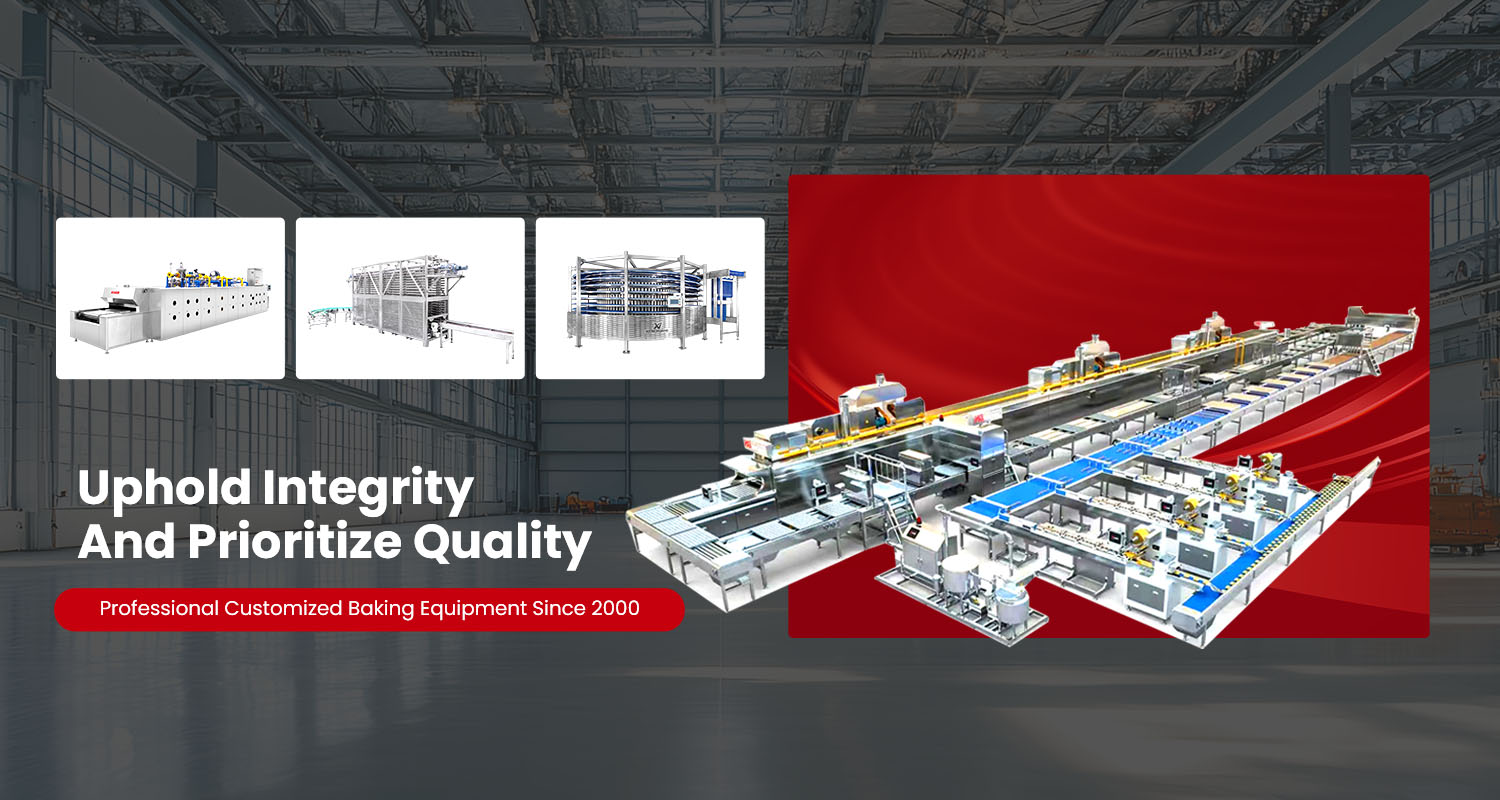
Croissant Production Line
A croissant production line is an automated baking system that transforms flour, butter, yeast, and other ingredients into finished croissants through a series of connected processing stages. It combines dough mixing, lamination, cutting, shaping, proofing, baking, and cooling to create pastries with a crisp exterior and delicate layered interior.
Unlike ordinary bread production, croissant manufacturing requires precise handling of dough and fat to develop its characteristic flaky structure. Each stage influences how the layers separate during baking and determines the final appearance and texture.
What Is a Croissant Production Line?
A croissant production line is a combination of food processing machines designed to manufacture croissants through a continuous or coordinated workflow.
The system typically starts with dough preparation and continues through lamination, forming, fermentation, and baking. Depending on the production arrangement, additional equipment may be used for filling, cooling, chocolate coating, and packaging.
The most important part of the process is lamination. This technique creates alternating layers of dough and butter or other suitable fat. When exposed to oven heat, moisture in the dough produces steam, helping separate the layers and create the familiar flaky texture.
How Does an Automated Croissant Production Line Work?
Croissant manufacturing involves several stages that must work together to maintain dough structure and product consistency.
1. Ingredient Preparation and Dough Mixing
The process begins with ingredients such as wheat flour, water, yeast, sugar, salt, milk, and other recipe components.
An industrial spiral mixer combines these ingredients into a uniform dough. Mixing develops the gluten structure, which gives the dough enough elasticity to withstand subsequent sheeting and folding.
The dough may then be rested or chilled to relax its structure and maintain a suitable temperature before lamination.
2. Dough Sheeting and Lamination
Lamination is the defining process in croissant production.
A dough sheeter gradually reduces the dough into a flat sheet. Butter or another suitable fat is placed inside or applied between layers of dough.
The combined sheet passes through folding and rolling operations several times. Each cycle creates additional alternating layers of dough and fat.
Temperature control is particularly important. If the fat becomes too soft, it may spread into the dough instead of remaining in distinct layers. If it becomes too hard, it may break during rolling and create uneven lamination.
3. Dough Cutting
After lamination, the dough sheet passes through cutting equipment that divides it into triangular pieces.
The dimensions of each triangle influence the final croissant size and shape. Consistent cutting also helps ensure that the products have similar baking characteristics.
4. Croissant Rolling and Shaping
The triangular dough pieces are transferred to a forming machine, which rolls them from the wider end toward the pointed tip.
This process creates the characteristic layered spiral appearance. Some products are also curved into a crescent shape, while others retain a straighter form.
Filled croissants may receive chocolate, fruit paste, or other fillings before or during shaping, depending on the equipment configuration.
5. Final Proofing
The shaped croissants are placed in a proofing chamber where temperature and humidity are controlled.
During fermentation, yeast produces carbon dioxide, causing the dough to expand. This increases product volume and contributes to a lighter internal texture.
Proofing conditions must also protect the laminated structure. Excessive heat may soften the fat layers and reduce the separation needed for a flaky result.
6. Baking
The proofed croissants enter an oven where heat causes the dough to expand further and the laminated layers to separate.
Moisture evaporates, the exterior becomes crisp, and the surface develops its characteristic golden-brown colour.
Baking temperature, airflow, and duration influence crust formation, internal texture, and overall appearance.
7. Cooling and Packaging
Freshly baked croissants are transferred to cooling conveyors after leaving the oven.
Allowing sufficient cooling time helps prevent condensation inside packaging. Depending on the product, additional processes may include cream injection, chocolate decoration, glazing, or individual wrapping.
What Equipment Is Used in a Croissant Production Line?
Different machines perform specific functions throughout the manufacturing process.
| Equipment | Main Function |
|---|---|
| Spiral dough mixer | Mixes ingredients into uniform dough |
| Dough Sheeter | Reduces dough thickness |
| Laminating Machine | Creates alternating dough and fat layers |
| Dough Cutter | Cuts laminated sheets into triangles |
| Croissant Forming Machine | Rolls and shapes dough pieces |
| Proofing Chamber | Controls fermentation conditions |
| tunnel oven | Bakes croissants continuously |
| Cooling Conveyor | Reduces product temperature |
| Filling Machine | Injects fillings into finished products |
| Packaging Machine | Wraps and seals finished croissants |
Not every production line requires all these machines. Equipment arrangements vary according to product shape, filling requirements, and the selected baking process.
What Are the Different Types of Croissants Made on Production Lines?
Croissant production systems can process different pastry styles by adjusting dough formulation, cutting patterns, filling methods, and shaping operations.
Classic Butter Croissants: These have a crescent shape, golden crust, and multiple flaky layers. Their texture depends heavily on proper butter distribution during lamination.
Chocolate Croissants: Chocolate is placed inside the dough before shaping. These products are often formed into straight or rectangular shapes rather than traditional crescents.
Mini Croissants: Smaller portions of laminated dough are cut and rolled into compact products. Their reduced size requires suitable proofing and baking adjustments.
Filled Croissants: Fruit, cream, chocolate, or other fillings can be added during forming or after baking, depending on the recipe.
Frozen Croissants: These may be frozen before or after baking. Unbaked frozen products generally require suitable thawing and proofing conditions before they are placed in the oven.
Croissant Production Line vs. Bread Production Line: What Is the Difference?
Although both processes use flour, water, and yeast, their production methods are significantly different.
| Comparison | Croissant Production | Bread Production |
|---|---|---|
| Main process | Dough lamination and folding | Mixing and fermentation |
| Fat application | Multiple layers of butter or fat | Usually mixed into dough |
| Forming | Cutting and rolling | Dividing and shaping |
| Texture | Flaky and layered | Soft or chewy crumb |
| Key process control | Fat and dough temperature | Fermentation and dough development |
The main difference is lamination. Croissants rely on distinct dough and fat layers, while conventional bread develops its structure primarily through gluten formation and fermentation.
What Factors Affect Croissant Quality?
Several production conditions influence the appearance, flavour, and texture of finished croissants.
Dough Temperature: Excessive warmth can soften the fat and damage the laminated structure.
Layer Thickness: Uneven sheeting may produce inconsistent layers, affecting expansion during baking.
Fat Distribution: Poorly distributed butter can result in irregular internal separation and uneven texture.
Proofing Conditions: Insufficient proofing may produce dense croissants, while excessive proofing can weaken their structure.
Baking Conditions: Incorrect temperature or baking duration may cause pale surfaces, excessive browning, or an underbaked interior.
Maintaining suitable conditions throughout the process is essential because problems introduced during lamination or forming may become more visible after baking.
Frequently Asked Questions
Why Do Croissants Have So Many Layers?
Croissants are made through lamination, which repeatedly folds dough and butter together. During baking, steam separates these layers and creates their characteristic flaky structure.
What Is the Difference Between a Dough Sheeter and a Laminating Machine?
A dough sheeter reduces dough thickness by passing it through rollers. A laminating machine combines sheeting and folding operations to create multiple alternating layers of dough and fat.
Why Must Croissant Dough Be Kept Cool?
Cool conditions help maintain the consistency of the butter or fat during lamination. If the fat melts or becomes too soft, the layers may merge and reduce the finished pastry's flakiness.
How Long Does Croissant Dough Need to Proof?
Proofing time varies according to the recipe, yeast activity, dough temperature, and humidity. The dough should expand sufficiently before baking without losing its structure.
Can Croissants Be Filled Before Baking?
Yes. Chocolate, fruit paste, and other suitable fillings can be placed inside the dough before rolling. Cream-based fillings are also commonly injected after baking.
Why Are Croissants Cooled Before Packaging?
Cooling allows excess heat and moisture to escape. Packaging croissants while they are still too warm may cause condensation, affecting their crisp exterior and storage quality.
A croissant production line combines specialized dough handling, lamination, forming, proofing, and baking processes to create pastries with their distinctive layered texture. Careful control of temperature, fat distribution, dough thickness, and fermentation is essential at every stage of production.
Previous: