





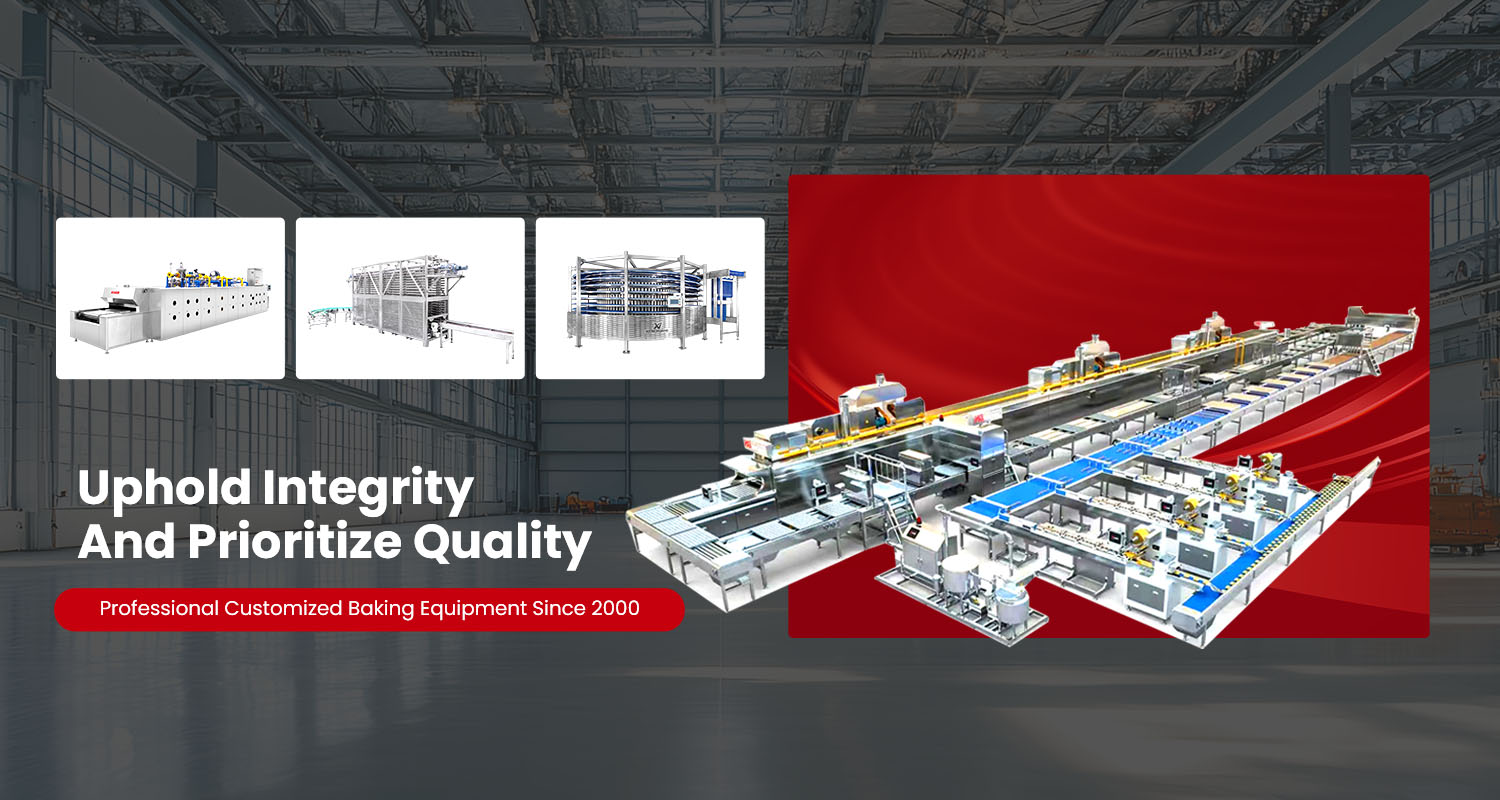
Biscuit & Cookie Production Line
A biscuit and cookie production line is an integrated food processing system that transforms flour, sugar, fats, and other ingredients into finished baked products. It combines mixing, dough forming, cutting, baking, cooling, and packaging equipment to create biscuits and cookies with consistent shapes, textures, and colours.
Although biscuits and cookies share many ingredients, their dough characteristics and forming methods can be quite different. From crisp crackers and hard biscuits to soft cookies and chocolate chip varieties, each product requires suitable processing conditions to achieve its intended texture and appearance.
What Is a Biscuit & Cookie Production Line?
A biscuit and cookie production line consists of connected machines that perform different stages of commercial biscuit manufacturing.
The process usually begins with ingredient preparation and dough mixing. The dough is then transferred to forming equipment, where it is shaped according to the desired product design. After forming, the pieces enter a tunnel oven for baking and move through cooling conveyors before reaching inspection and packaging.
Depending on the product, the line may include additional equipment for dough resting, cream filling, chocolate coating, or sandwich biscuit assembly.
The equipment arrangement and production method depend on the dough formulation, product thickness, shape, and required texture.
How Does a Biscuit & Cookie Production Line Work?
Although production details vary, most automated biscuit and cookie manufacturing processes follow several main stages.
1. Ingredient Preparation
The process starts with ingredients such as wheat flour, sugar, butter or vegetable fat, water, milk powder, salt, and raising agents.
Ingredients are measured according to the recipe. Proper weighing is important because variations in flour, fat, or moisture content can influence dough consistency and the final product.
Some recipes also include cocoa powder, chocolate chips, nuts, or flavouring ingredients.
2. Dough Mixing
An industrial mixer combines the ingredients into a uniform dough.
Different mixing methods are used depending on the product. Hard biscuit dough generally requires controlled gluten development, while soft cookie dough often contains more fat and sugar and needs a different mixing approach.
Mixing time, speed, and ingredient temperature influence the dough's elasticity, consistency, and ability to pass through forming equipment.
3. Dough Resting and Feeding
Some dough formulations require a resting period before shaping. Resting allows moisture to distribute more evenly and helps relax the dough structure.
The prepared dough is then transferred to the forming section through feeding equipment or conveyor systems.
4. Dough Forming
Forming equipment shapes the dough into individual biscuit or cookie pieces. The selected method depends on the dough texture and product design.
Rotary moulding, wire-cutting, and sheeting are among the common forming methods used in biscuit and cookie manufacturing.
5. Baking
The formed dough pieces enter a tunnel oven, where controlled heat transforms them into finished baked products.
During baking, moisture evaporates, starch and proteins undergo structural changes, and the surface develops its characteristic colour.
Temperature and conveyor speed influence the final crispness, texture, and degree of browning.
6. Cooling
After baking, products move onto cooling conveyors or through spiral cooling systems.
Cooling allows biscuits and cookies to stabilize before further handling. Packaging products while they are still too warm may cause condensation and affect their texture.
7. Inspection and Packaging
Cooled products can pass through inspection equipment before packaging.
Depending on the product, additional operations may include cream filling, chocolate coating, sandwich assembly, or individual wrapping.
What Are the Different Biscuit and Cookie Forming Methods?
The forming process is one of the most important differences between biscuit and cookie production.
Rotary Moulding
Rotary moulding machines use a rotating cylinder with engraved cavities to shape dough into individual pieces.
Dough is fed into the moulding section, pressed into the cavities, and released onto a conveyor.
This method is commonly used for short dough biscuits and products with detailed surface patterns. It can create consistent shapes, thicknesses, and decorative designs.
Wire-Cut Forming
Wire-cut machines process relatively soft cookie dough by feeding it through a depositing or extrusion mechanism and cutting portions with a wire.
The method is particularly suitable for chocolate chip cookies, butter cookies, and other products with soft or chunky dough.
It can also accommodate ingredients such as nuts and chocolate pieces, depending on the equipment design.
Dough Sheeting and Cutting
Sheeting systems flatten dough into a continuous layer using rollers. Rotary cutters or stamping equipment then cut the sheet into specific shapes.
This method is commonly used for hard biscuits, crackers, and products requiring uniform thickness.
Excess dough from the cutting process may be collected and returned to the appropriate processing stage when the recipe and food safety procedures permit.
What Equipment Is Used in a Biscuit & Cookie Production Line?
Different machines perform specific functions throughout the manufacturing process.
| Equipment | Main Function |
|---|---|
| Flour Sifter | Removes lumps and foreign particles |
| Ingredient Mixer | Combines ingredients into dough |
| Dough Feeder | Transfers dough to forming equipment |
| Rotary Moulder | Forms patterned biscuit pieces |
| Wire-Cut Machine | Portions soft cookie dough |
| Dough Sheeter | Produces uniform dough sheets |
| Rotary Cutter | Cuts dough into individual shapes |
| Tunnel Oven | Bakes biscuits and cookies |
| Cooling Conveyor | Reduces product temperature |
| Cream Sandwiching Machine | Adds filling between biscuit layers |
| Chocolate Coating Machine | Applies chocolate to finished products |
| Packaging Machine | Wraps and seals finished products |
Not every production line requires all these machines. The equipment combination depends on the product type and the processing stages involved.
What Is the Difference Between Biscuit and Cookie Production?
Biscuits and cookies share many ingredients, but their formulations and processing characteristics can differ.
| Comparison | Biscuits | Cookies |
|---|---|---|
| Dough texture | Often firmer and less sticky | Frequently softer and richer |
| Fat content | Varies by product | Often relatively higher |
| Sugar content | Depends on biscuit type | Commonly higher in sweet varieties |
| Forming methods | Sheeting, rotary moulding | Wire-cutting, depositing, moulding |
| Final texture | Often crisp and firm | Crisp, chewy, or soft |
| Typical products | Crackers, hard biscuits, tea biscuits | Chocolate chip, butter, soft cookies |
These differences are not absolute. Some biscuits use soft dough, while certain cookies are designed to become crisp after baking. The recipe and intended product characteristics determine the appropriate manufacturing process.
What Types of Products Can Be Made on These Production Lines?
Different recipes and forming methods allow a wide variety of baked products to be manufactured.
Hard Biscuits: These products usually have a firm structure and crisp texture. They are commonly formed through sheeting and cutting.
Soft Cookies: Higher fat and sugar content can create a softer dough that is suitable for depositing or wire-cutting.
Butter Cookies: These products use butter or other fats to develop a rich flavour and delicate texture. Their shapes are often created through moulding or depositing.
Chocolate Chip Cookies: Chocolate pieces are incorporated into the dough before forming. Wire-cutting is a common method for producing individual portions.
Cream Sandwich Biscuits: Two baked biscuit pieces are combined with a cream filling between them.
Crackers: These products generally require carefully controlled dough preparation and baking to achieve a thin, dry, crisp structure.
What Factors Affect Biscuit and Cookie Quality?
Several processing conditions influence the final appearance, flavour, and texture of baked products.
Ingredient Proportions: Variations in flour, sugar, fat, and water can change dough consistency and product structure.
Mixing Conditions: Insufficient mixing may create uneven dough, while excessive mixing can affect gluten development and forming behaviour.
Dough Temperature: Temperature influences fat consistency, dough elasticity, and the way products pass through forming equipment.
Forming Accuracy: Uneven thickness or inconsistent portion sizes can lead to differences in baking time and finished product appearance.
Oven Temperature: Incorrect heating conditions may cause pale surfaces, excessive browning, or uneven internal moisture.
Cooling Time: Insufficient cooling can cause moisture accumulation during packaging and affect product crispness.
How to Maintain a Biscuit & Cookie Production Line?
Regular cleaning and equipment inspection help maintain stable production conditions.
Clean Mixing and Forming Equipment
Remove residual dough, flour, and ingredients from mixers, feeders, rollers, and moulding surfaces. Follow the manufacturer's cleaning instructions to prevent residue buildup.
Inspect Cutting and Moulding Components
Check moulding rollers, cutting blades, and wire-cut mechanisms for wear or damage. These components directly affect product shape and portion consistency.
Monitor Tunnel Oven Performance
Inspect heating elements, burners, temperature sensors, and ventilation systems to identify abnormal operating conditions.
Maintain Cooling Conveyors
Remove crumbs and accumulated food particles from conveyor surfaces. Check belt tension, alignment, and drive components regularly.
Follow Preventive Maintenance Procedures
Lubrication, electrical inspections, and replacement of worn components should follow the equipment manufacturer's recommendations.
What Are Common Problems in Biscuit and Cookie Production?
Uneven Product Shapes: Incorrect forming pressure, inconsistent dough feeding, or worn moulding components may cause irregular shapes.
Dough Sticking: Excessive moisture, unsuitable dough temperature, or residue on forming surfaces can make dough difficult to release.
Cracked Biscuits: Incorrect dough formulation, insufficient moisture, or unsuitable baking conditions may contribute to surface cracking.
Uneven Browning: Inconsistent oven temperature, poor airflow, or irregular product spacing may cause colour differences.
Soft or Soggy Products: Insufficient baking or inadequate cooling may leave excessive moisture in finished biscuits.
Broken Products During Transfer: Poorly designed conveyor connections or excessive mechanical impact may damage fragile biscuits after baking.
Identifying the processing stage responsible for each problem helps prevent unnecessary adjustments to other parts of the production line.
Frequently Asked Questions
How Long Does It Take to Produce Biscuits on an Automated Line?
Production time depends on the dough preparation method, forming process, oven length, conveyor speed, and cooling requirements. Different products require different processing conditions.
Can One Production Line Make Both Biscuits and Cookies?
Some production lines can handle multiple product types through interchangeable forming equipment and adjustable processing settings. However, the dough characteristics and required equipment configuration must be considered.
Why Are Tunnel Ovens Commonly Used in Biscuit Production?
Tunnel ovens provide continuous baking and allow temperature and conveyor speed to be controlled. This helps maintain consistent baking conditions for products moving through the oven.
What Is the Purpose of Cooling After Baking?
Cooling allows moisture and residual heat to escape before products are handled or packaged. It also helps biscuits and cookies stabilize and develop their final texture.
Can Chocolate Chip Cookies Be Made with Rotary Moulding?
Wire-cutting or depositing is generally more suitable for soft chocolate chip cookie dough because it can portion dough containing solid inclusions. The appropriate method depends on dough consistency and chocolate piece size.
Why Do Biscuits Break Easily After Baking?
Excessive dryness, insufficient structural strength, improper cooling, or rough product handling may contribute to breakage. The causes should be evaluated throughout the production process.
A biscuit and cookie production line combines ingredient preparation, dough mixing, forming, baking, and cooling into a coordinated manufacturing process. The choice of forming method and control of dough properties are especially important because they determine the shape, texture, and appearance of finished biscuits and cookies.
Previous: How to Use Bakery Oven
Next: Conveyor Tunnel Oven