





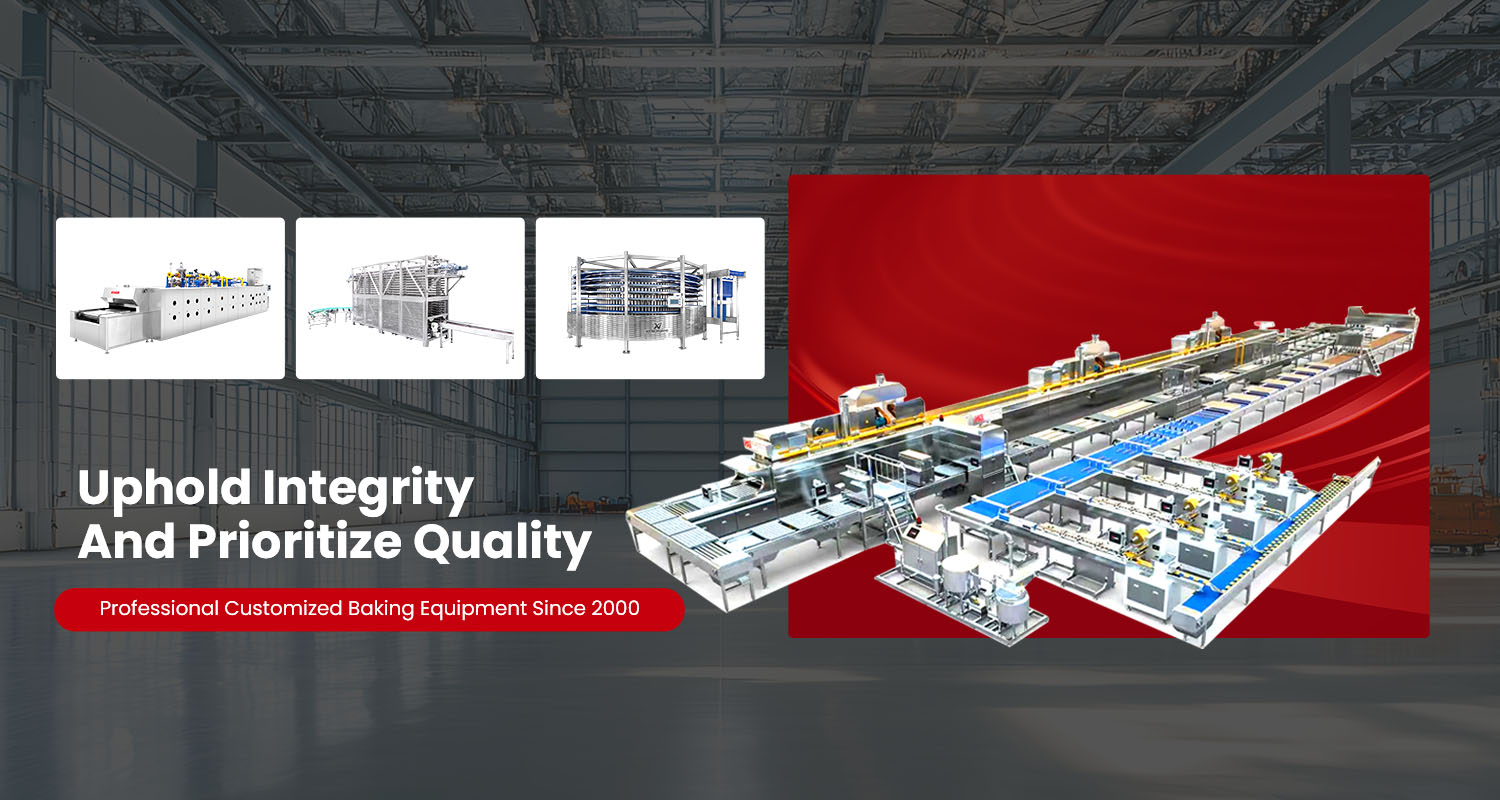
What Is Industrial Baking Oven System?
Continuous bakery production depends on stable heat, product movement, and repeatable baking time. An industrial baking oven system combines these functions so bread, buns, cakes, biscuits, and pastries pass through defined heating stages without repeated manual loading. Its role is to maintain consistent color, texture, moisture, and internal structure during continuous output.
How Continuous Baking Works
Products enter on trays, steel belts, mesh belts, or another surface selected for the recipe. Conveyor speed determines residence time, while separate heating zones create the required profile from loading to discharge.
The first zone starts heat transfer and supports expansion. Middle zones complete most of the internal bake, while final zones control surface color and discharge condition. Operators adjust temperature, speed, airflow, and exhaust according to the product.
Unlike batch ovens, tunnel oven equipment receives products continuously at one end and delivers them at the other.
Main Components and Heating Zones
A typical system includes an insulated chamber, variable-speed conveyor, independent heating zones, burners or electric heaters, circulation fans, exhaust devices, sensors, safety interlocks, recipe storage, and alarm controls.
One temperature is rarely suitable for the entire bake. Expansion, structure formation, moisture release, and surface coloring occur at different stages. A zoned baking heat system lets each section apply a suitable heat level.
Strong early heat may support bread volume, while lower heat near discharge can limit excessive browning. Biscuits may need a different balance between top and bottom heat to control spread and crispness.
Capacity and Baking Time
Capacity should be calculated from unit weight, pieces per row, belt width, loading gaps, and required baking time. Increasing conveyor speed raises output only when the product can still complete its bake within the shorter residence time.
Factories should distinguish between maximum and sustainable speed. Warm-up, cleaning, changeovers, short stops, and maintenance reduce actual daily output. A practical industrial baking oven solution therefore needs enough margin to handle normal variation.
Data Required Before Selection
Before specifying a tunnel oven system for bakery production, prepare:
Product dimensions, weight, and recipe range
Required hourly output and shift length
Baking time and target temperature profile
Tray, belt, or direct-baking method
Gas, electricity, ventilation, and exhaust conditions
Inlet and outlet heights for connected machines
These details help prevent mismatches between oven size, process needs, and downstream capacity.
Key Design Factors
| Factor | Why It Matters | What to Verify |
|---|---|---|
| Heating zones | Shape the baking profile | Recipe stages and trials |
| Belt width | Determines loading area | Rows, gaps, side clearance |
| Heat source | Affects utilities | Factory supply conditions |
| Exhaust | Influences moisture | Product finish during tests |
Integration Hygiene and Maintenance
The oven should not operate as an isolated machine. Proofing output must match oven loading, while cooling and depanning equipment must receive products at the correct speed. When downstream equipment slows, controls should protect products already inside the chamber.
Crumbs and residue may collect on belts, chamber surfaces, and return sections. Access doors, collection points, removable guards, and clear sanitation procedures support cleaning.
Preventive maintenance should cover burners or heaters, sensor calibration, belt tracking, fans, exhaust paths, seals, and safety devices. Critical drives, sensors, and heating parts should be included in the spare-parts plan.
A properly specified oven creates a repeatable relationship between heat, time, airflow, and product movement. Product samples, process data, plant drawings, and utility information support quality, practical maintenance, and future production growth.