





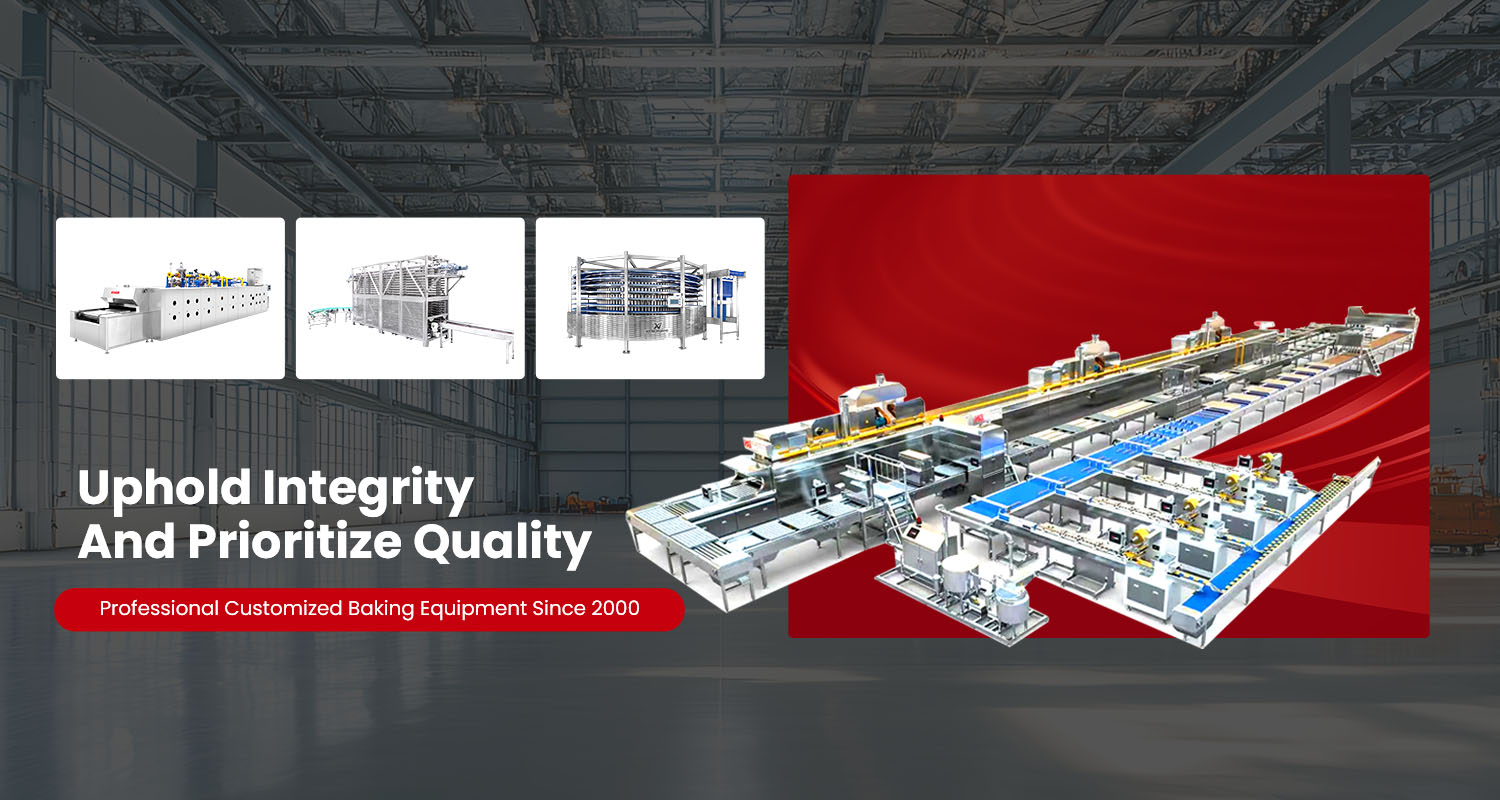
What Is an Industrial Baking Oven System?
An industrial baking oven system is a continuous thermal-processing solution designed to bake bread, cakes, biscuits, mooncakes, and similar foods at controlled temperatures and production speeds. It combines heating, conveying, airflow management, exhaust, and automatic controls to deliver consistent color, moisture, texture, and output across every batch.
How Does the System Complete the Baking Process?
Products enter the oven on trays, pans, steel belts, or mesh conveyors. The conveyor moves them through several temperature zones, allowing the baking profile to change gradually. Early zones support dough expansion, middle zones complete internal baking, and final zones control surface color and moisture removal.
Unlike a standalone batch oven, tunnel oven equipment maintains continuous movement. Its operating speed must therefore match upstream fermentation or forming equipment and downstream depanning, cooling, sorting, and packaging machines.
What Are the Main System Components?
A complete industrial baking oven system normally includes:
An insulated oven chamber that limits heat loss
Gas, electric, or hybrid heating devices
Conveyor drives and tension-control mechanisms
Independent temperature and airflow zones
Moisture and exhaust-control units
PLC recipes, alarms, and production monitoring
Safety devices for flame, pressure, temperature, and conveyor faults
The design of the baking heat system depends on the product. Soft bread requires stable heat penetration without excessive crust formation, while biscuits generally need stronger moisture removal and accurate color control.
| System Area | Main Function | Purchasing Focus |
|---|---|---|
| Heating zones | Create the required baking curve | Temperature uniformity |
| Conveyor | Carry products continuously | Speed range and load |
| Air circulation | Distribute heat across the chamber | Left-to-right consistency |
| Exhaust | Remove moisture and combustion gases | Adjustable extraction |
| Control panel | Store and repeat recipes | Data and alarm functions |
How Is Heat Transferred to the Product?
Industrial ovens use radiation, convection, and conduction in different proportions. Radiation transfers energy from heated surfaces or burners. Convection circulates hot air around the product, while conduction occurs where a pan or belt touches the dough.
Manufacturers adjust burner positions, ducts, dampers, chamber height, and zone length to create an appropriate balance. A poorly distributed airflow pattern can cause pale centers, dark edges, uneven moisture, or differences between upper and lower trays.
Which Factors Determine Oven Capacity?
Required capacity should be calculated from product weight, pieces per row, row spacing, belt width, baking time, and operating hours. Maximum mechanical speed alone is not a reliable capacity indicator.
The selected tunnel oven system for bakery operations must also accommodate product changeovers. Buyers should provide representative recipes, pan dimensions, target hourly output, fuel conditions, available floor space, and expected future products before engineering begins.
What Should Be Evaluated Before Purchase?
Energy consumption should be considered together with product quality, insulation performance, maintenance access, cleaning requirements, and usable production rate. A lower initial price may create higher operating costs when heat leakage, long changeovers, or uneven baking leads to waste.
A practical industrial baking oven solution should integrate with the complete line rather than operate as an isolated machine. Confirming interfaces, conveyor heights, control signals, utility connections, and commissioning responsibilities before manufacturing reduces installation delays and supports stable long-term production.