





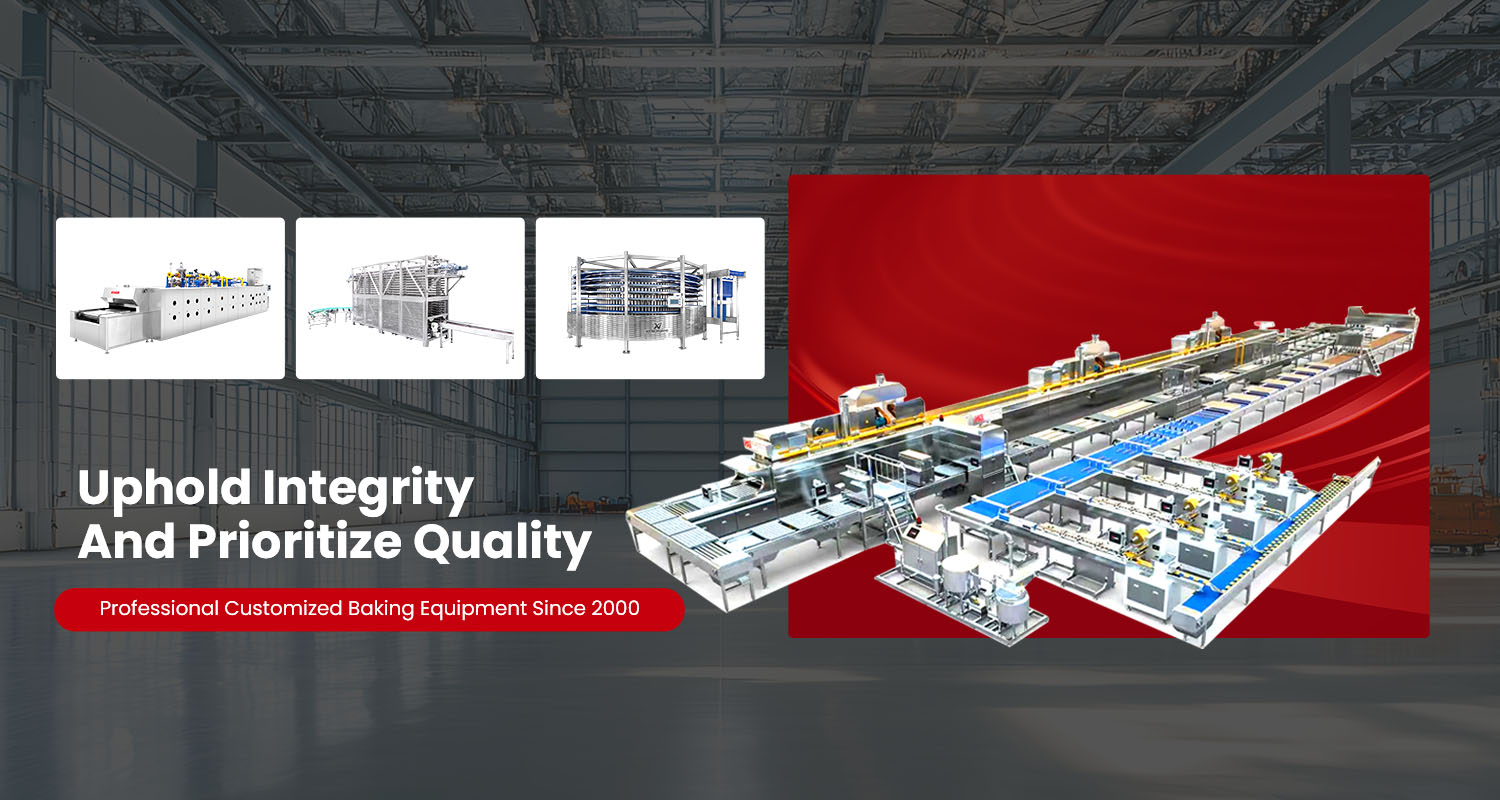
How to Select an Automatic Production Line?
Selecting an automatic production line requires more than comparing output figures. The correct line must match the product recipe, process sequence, factory utilities, labor plan, packaging method, hygiene requirements, and future capacity. A well-engineered system creates balanced production instead of moving bottlenecks from one machine to another.
Define the Product Before Comparing Equipment
Begin with the products the factory plans to manufacture. Record dough characteristics, unit weight, dimensions, pan or tray specifications, fermentation time, baking profile, cooling requirement, packaging format, and acceptable changeover duration.
Bread, cake, and mooncake lines require different handling methods. Delicate or high-moisture products may need gentler transfers, while pan-baked products require accurate coordination among fermentation, baking, depanning, cooling, and sorting processes.
| Information Required | Why It Matters |
|---|---|
| Target output per hour | Determines machine and conveyor capacity |
| Product dimensions | Defines belt width and lane arrangement |
| Processing time | Influences tower, oven, and conveyor length |
| Packaging format | Determines sorting and discharge design |
| Available utilities | Affects motors, burners, air, and controls |
| Factory layout | Controls equipment arrangement and access |
These details allow a manufacturer to develop an industrial automation system around actual production conditions rather than a generic capacity estimate.
Check Whether Every Process Has Balanced Capacity
The slowest operation determines the usable output of a food production line. A high-speed forming machine provides little benefit when the Fermentation Tower, tunnel oven, cooling system, or packaging section cannot receive the same product volume.
When buyers choose an automated bakery production line, they should request capacity calculations for every major section. The evaluation should include normal output, peak load, planned downtime, product losses, and buffer capacity. Manufacturers should also explain how the line responds when one section stops.
Evaluate Automation and Changeover Requirements
More automation does not automatically mean better performance. The appropriate level depends on production volume, SKU variety, labor cost, sanitation standards, and operator experience.
Useful functions may include recipe storage, synchronized speed adjustment, temperature recording, fault alarms, automatic tracking, remote diagnosis, and production-data collection. Factories producing several product sizes should also examine tool-free adjustment, change-part quantity, recipe switching, and cleaning time.
Controls should be easy for operators to understand. Clear alarm messages and accessible manual modes help maintenance teams identify faults without disrupting the entire line for minor problems.
Review Installation and Long-Term Operation
Before approving an industrial automation solution, confirm floor loading, ceiling height, equipment access, drainage, ventilation, power supply, gas pressure, compressed air, and fire-safety provisions. Large ovens and cooling towers may require reserved installation routes or sectional assembly.
The final comparison should cover spare parts, sanitation access, documentation, operator training, commissioning support, preventive maintenance, and expansion options. Suppliers should provide a layout, process flow, utility list, interface schedule, and performance acceptance criteria.
The best automatic production line is not simply the fastest. It is the system that repeatedly meets product standards, maintains balanced flow, supports manageable changeovers, and leaves sufficient flexibility for future production needs.