





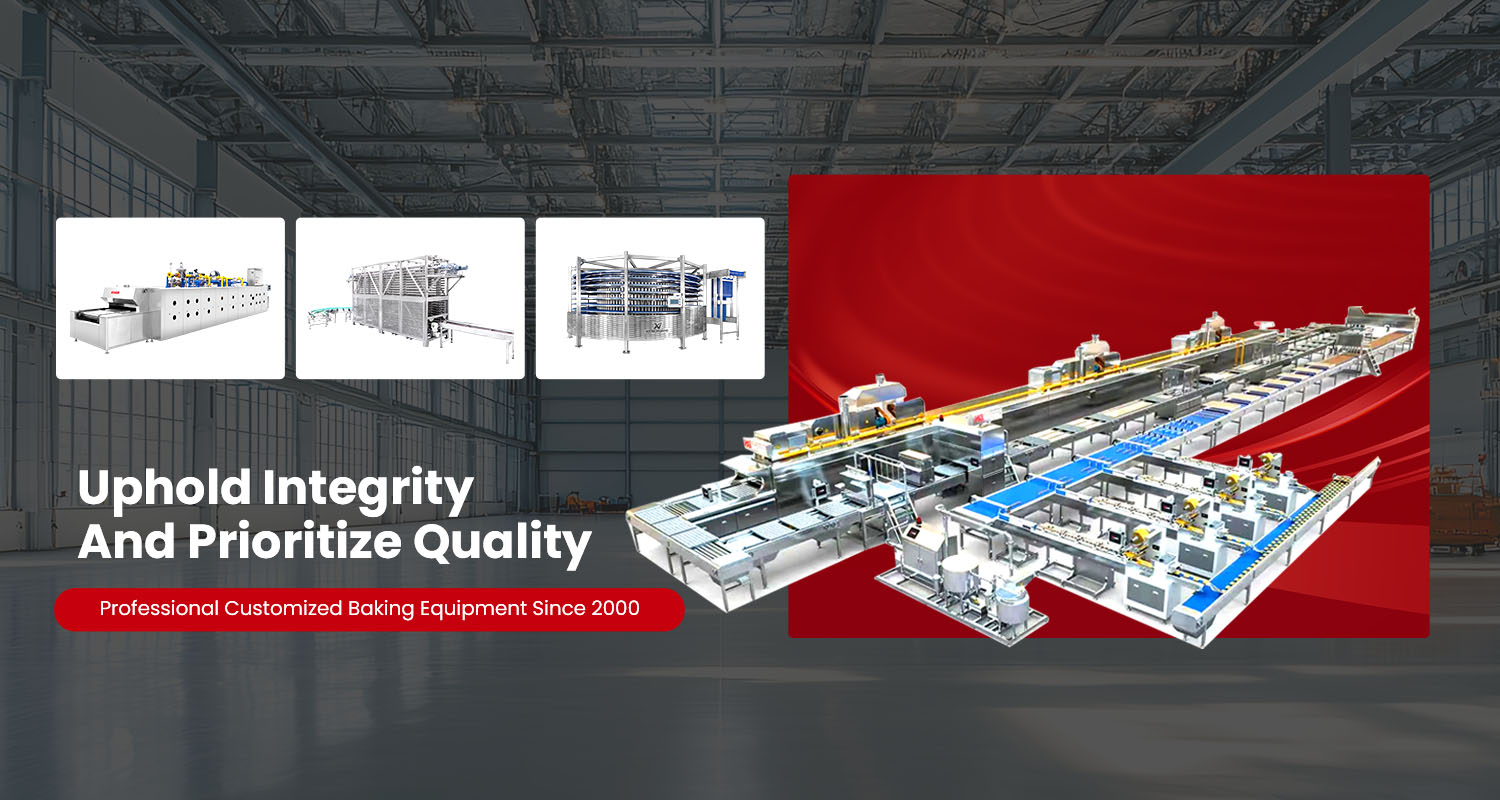
What Is an Integrated Bakery System?
An integrated bakery system connects ingredient handling, dough processing, fermentation, baking, cooling, depanning, sorting, and packaging into one coordinated production flow. Instead of operating each machine separately, the system synchronizes capacities, conveyor speeds, controls, and product transfers to improve consistency and reduce unnecessary manual handling.
How Does an Integrated System Operate?
Production begins with ingredient storage and automatic dosing. Flour, water, oil, sugar, and other materials are delivered according to stored formulas before entering the mixing and forming stages. The product then moves through proofing, surface treatment, baking, depanning, cooling, and packaging according to its process requirements.
Every section of the complete production line must exchange operating signals. When an oven slows down or a packaging machine stops, upstream equipment should respond without causing product accumulation, deformation, or excessive fermentation. Buffers may be installed between critical stages to absorb short interruptions.
This connected approach is particularly valuable for bread, cakes, buns, biscuits, and mooncakes produced in large volumes. However, the layout and automation method must be designed around the actual product rather than copied from another factory.
What Equipment Can Be Included?
An integrated bakery production solution may contain flour silos, dosing units, mixers, dough dividers, molding machines, Fermentation Towers, Liquid Brushing Applicators, tunnel ovens, depanners, Spiral Cooling Towers, sorting conveyors, and packaging interfaces.
The exact configuration depends on whether products are baked on pans, trays, mesh belts, or steel belts. Cooling time, product fragility, required hygiene level, and packaging orientation also affect equipment selection.
A manufacturer must calculate the operating capacity of every section. Installing a fast forming machine does not increase real output when the fermentation, baking, or cooling section has insufficient capacity. Line balance is therefore more important than the maximum speed printed on an individual machine specification.
Why Is System Integration Important?
A full bakery automation system can improve production in several areas:
Fewer manual transfers between processing stages
More stable product spacing and orientation
Repeatable fermentation and baking conditions
Lower risk of contamination and handling damage
Centralized recipe, alarm, and speed management
Easier production-data collection and traceability
Integration also affects food quality. Uncontrolled transfer time may change dough temperature or proofing results, while irregular cooling can create condensation inside the package. Coordinating the entire process helps maintain the intended texture, moisture, shape, and shelf-life conditions.
What Should a Turnkey Proposal Confirm?
A turnkey solution system should define more than the supplied equipment. It should clarify factory layout, utilities, interfaces, installation responsibilities, commissioning procedures, acceptance standards, training, documentation, and spare parts.
| Project Item | Information to Confirm |
|---|---|
| Product range | Dimensions, weights, recipes, and pan types |
| Production target | Normal and peak hourly output |
| Factory conditions | Space, ceiling height, drainage, and access |
| Utilities | Power, gas, water, air, and ventilation |
| Automation scope | Recipes, tracking, alarms, and data exchange |
| Acceptance test | Capacity, quality, waste, and operating stability |
Manufacturers should receive representative product and factory data before finalizing the design. A properly planned integrated bakery system creates a continuous production process in which equipment, controls, utilities, and operators work as one coordinated unit.